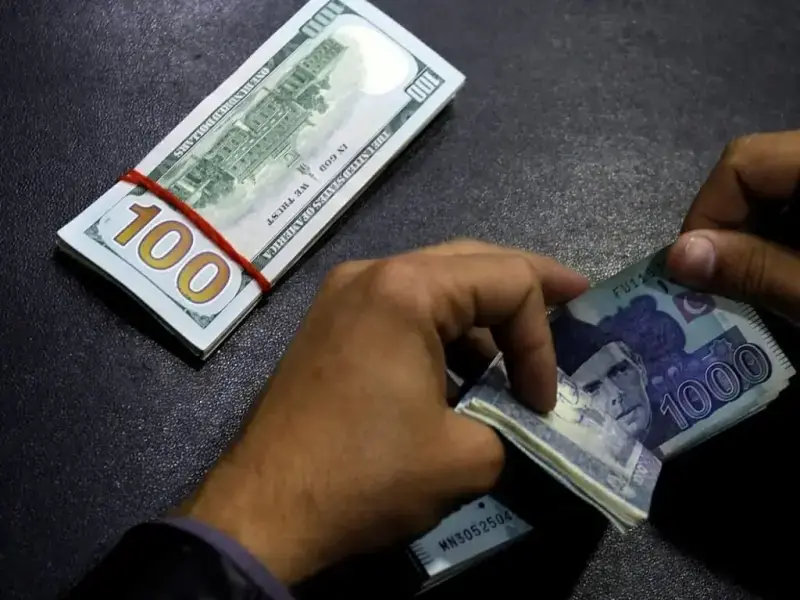

The Pakistani rupee strengthened against the US dollar, appreciating 0.01% in the inter-bank market on Monday.
At close, the local currency settled at 279.92, a gain of Re0.03 against the greenback.
During the previous week, the Pakistani rupee posted a marginal gain, appreciating by Re0.07 or 0.03% against the US dollar in the interbank market.
The local unit closed at 279.95, compared to 280.02, which it had closed at the week before against the greenback, according to the State Bank of Pakistan (SBP).
Internationally, the US dollar fell on Monday as investors, unnerved by US President Donald Trump’s latest tariff threats against Europe over Greenland, piled into the safe-haven yen and Swiss franc, in a broad risk-averse move across markets.
Trump said over the weekend he would impose an additional 10% import tariff from February 1 on goods from Denmark, Norway, Sweden, France, Germany, the Netherlands, Finland and Britain, until the United States is allowed to buy Greenland.
Major European Union states decried the tariff threats over Greenland as blackmail on Sunday, with France proposing to respond with a range of previously untested economic countermeasures.
In the foreign exchange market, the initial knee-jerk reaction in early Asia trade was to sell the euro and sterling, in a move that pushed them to a seven-week low and one-month trough of $1.1572 and $1.3321, respectively.
However, the two currencies bounced from their lows and it was the dollar that came under pressure as the trading day got underway, as investors assessed the longer-term implications of Trump’s latest move on the greenback’s standing.
Investors had dumped the dollar in the wake of last April’s “Liberation Day” announcement when Trump unveiled sweeping tariffs on the world, triggering a crisis of confidence in US assets.
The dollar index eased slightly to 99.18.
Oil prices, a key indicator of currency parity, fell 1% on Monday, reversing the previous session’s gains, as civil unrest in Iran subsided, lowering the chance of a U.S. attack that could disrupt supply from the major Middle Eastern producer.
Brent crude was trading at $63.48 a barrel at 0912 GMT, down 65 cents or 1%.
U.S. West Texas Intermediate for February fell 65 cents, or around 1%, to $58.84 a barrel. The contract expires on Tuesday and the more active March contract was at $58.77, down 57 cents, or 1%.







 American Dollar Exchange Rate