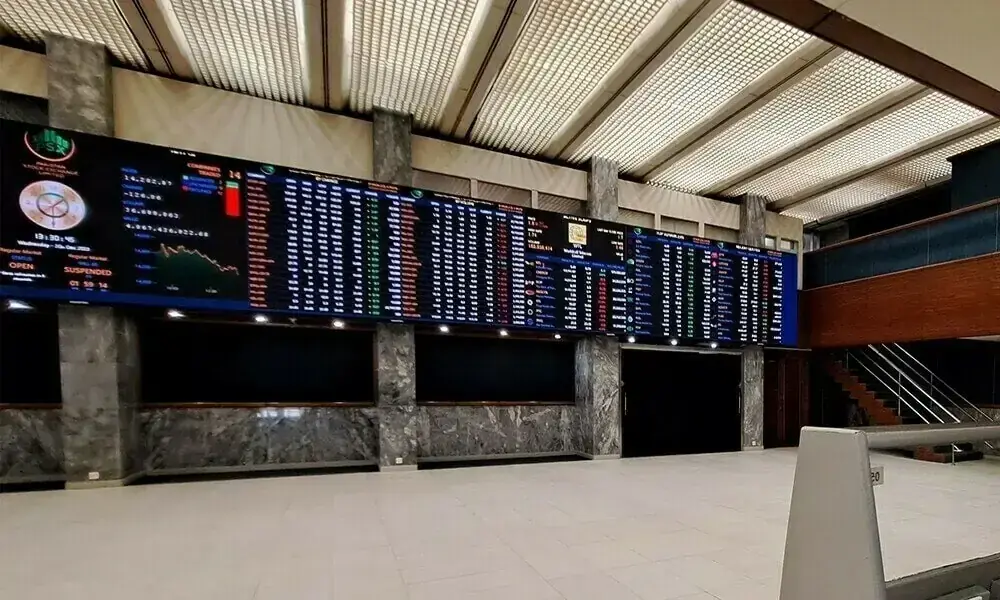

Selling continued at the Pakistan Stock Exchange (PSX) as tensions in the Middle East kept investors wary, with the benchmark KSE-100 Index shedding nearly 4,400 points during trading on Monday.
At 1:10pm, the benchmark index was hovering at 149,504.63, down by 4,361.53 points or 2.83%.
Selling pressure was observed in key sectors, including automobile assemblers, cement, commercial banks and power generation. Index-heavy stocks, including HUBCO, INDU, LUCK, HBL, MCB and MEBL, traded in the red.
“Fear is the primary driver as investors navigate a perfect storm of regional war and domestic fiscal uncertainty,” said Behtari Capital.
During the previous week, Pakistan’s stock market remained under sustained pressure as heightened geopolitical tensions, domestic security concerns and macroeconomic uncertainty continued to weigh heavily on investor sentiment.
The benchmark KSE-100 Index extended its losing streak, declining by 3,629.92 points on a week-on-week basis, representing a drop of 2.3% to close at 153,866.17 points.
Internationally, Asian markets were in a wary mood on Monday as hostilities in the Gulf kept oil prices elevated, complicating an inflation outlook that should keep most central banks on pause at policy meetings this week, barring one possible hike.
In a possible hint of hope, the Wall Street Journal reported the Trump administration plans to announce as early as this week that multiple countries have agreed to form a coalition to escort ships through the Strait of Hormuz.
US President Donald Trump told the Financial Times it would be very bad for the future of NATO if the allies did not help.
European Union foreign ministers will discuss on Monday bolstering a small naval mission in the Middle East, though any operation in the Strait would be fraught with risk.
Oil markets were cautious as Brent rose 0.8% to $104.01 a barrel, while U.S. crude fell 0.2% to $98.48.
Central banks in the US, UK, Europe, Japan, Australia, Canada, Switzerland and Sweden hold their first full meetings since the start of the war, with energy prices looming over all of them.
Japan’s Nikkei dipped 0.8%, while South Korean stocks added 0.2% after both lost ground last week. MSCI’s broadest index of Asia-Pacific shares outside Japan edged down 0.1%.
Chinese blue chips eased 0.5% as data showed retail sales and industrial output for January and February topped forecasts, while house prices continued to slip.
Top US and Chinese officials are also meeting in Paris to discuss potential deals in agriculture, critical minerals and managed trade for Trump and Chinese President Xi Jinping to consider when the U.S. president visits Beijing.
This is an intra-day update








 American Dollar Exchange Rate