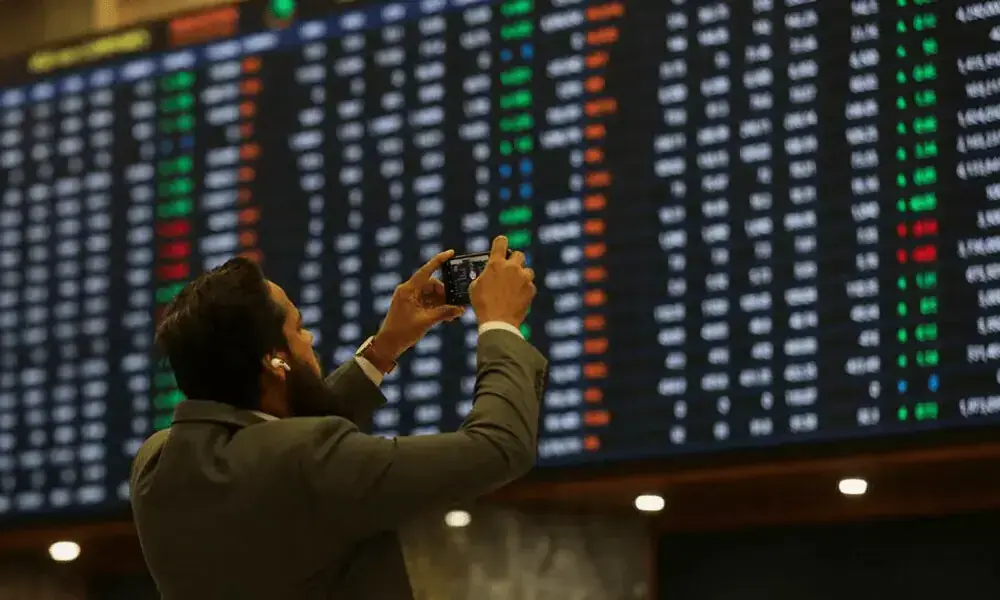
The Pakistan Stock Exchange (PSX) saw a bearish session dominated by selling pressure on Friday, with the benchmark KSE-100 Index closing the week below 180,000.

Negative sentiments were observed throughout much of the day. The benchmark index quickly came under pressure, dropping to an intra-day low of 178,237.13.
It recovered somewhat in the second half of the trading session but remained in the red.
At close, the KSE-100 Index settled at 179,603.73, a decrease of 908.91 points or 0.50%.
“This negativity in market can be accredited to ongoing result session, where corporate results have fell short of investor`s expectation,” brokerage house Topline Securities said in its post-market report.
Top negative contribution to the index came from LUCK, UBL, OGDC, SYS, EFERT and ENGROH, as they cumulatively weighed down on the index by 685 points, it added.
Arif Habib Ltd’s Ali Najib said investor confidence remained subdued throughout the sessions amid the absence of any positive catalyst.
The government is reportedly considering the imposition of a cess on fertiliser companies to recoup windfall profits, which will be ring-fenced for the benefit of farmers, well-informed sources told media.
On Thursday, the PSX remained under sustained selling pressure as heightened uncertainty, sector-wide weakness and negative sentiment surrounding large-scale mining investments triggered a sharp retreat across benchmark indices. The benchmark KSE-100 Index shed 2,537.16 points, or 1.39%, to settle at 180,512.65 points.
Globally, Asian shares retreated from record highs on Friday as worries about shrinking margins in the tech sector hit the likes of Apple, driving investors into safe-haven bonds ahead of key US inflation data.
On Wall Street overnight, the technology-heavy Nasdaq Composite tumbled 2% after Cisco Systems posted quarterly adjusted gross margin below estimates amid surging memory chip costs. That drove its shares down 12% and wiped out about $40 billion of its market cap.
The selloff spilt over into tech giants like Apple, which tumbled 5% in the biggest daily drop since April last year, when US President Donald Trump’s sweeping “Liberation Day” tariffs spooked markets. Transportation companies also got caught up in worries about AI disruption.
On Friday, MSCI’s broadest index of Asia-Pacific shares outside Japan fell 0.6%, trimming this week’s gain to 4.1%. Japan’s Nikkei skidded 0.9%, but was still up 5.3% for the week.
Chinese blue chips dropped 0.6% while Hong Kong’s Hang Seng index slid 1.5%.
Both Nasdaq futures and S&P 500 were up 0.1%, while EURO STOXX 50 futures climbed 0.2%.
Meanwhile, the Pakistani rupee registered marginal improvement against the US dollar, appreciaiting 0.01% in the inter-bank market on Friday. At close, the local currency settled at 279.62, a gain of Re0.03 against the greenback.
Volume on the all-share index decreased to 708.97 million from 873.99 million recorded in the previous close. The value of shares declined to Rs38.89 billion from Rs41.77 billion in the previous session.
K.Electric was the volume leader with 131.14 million shares, followed by Pak Int.Bulk with 34.70 million shares, and WorldCall Telecom with 33.83 million shares.
Shares of 481 companies were traded on Friday, of which 194 registered an increase, 231 recorded a fall, and 56 remained unchanged.





 American Dollar Exchange Rate