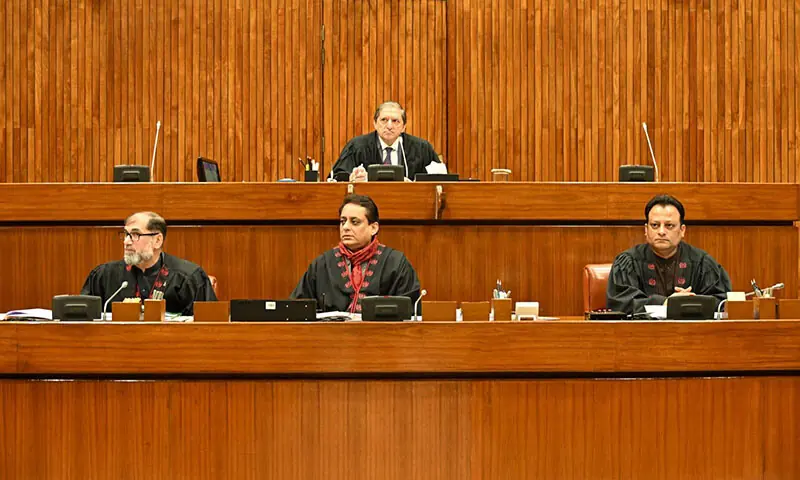

ISLAMABAD: In a significant move to assert parliamentary supremacy, a Senate rule was amended on Friday with the aim to curb judicial interference in parliamentary affairs.
The amendment to rule 166(5) of the Rules of Procedure and Conduct of Business in the Senate was approved by the upper House of Parliament as chair rejected the government’s request to defer the matter.
A motion seeking the amendment to the rule was moved by PPP, PML-N and Muttahida Qaumi Movement (MQM) senators.
However, during the session, PML-N’s Rana Sanaullah, who is special assistant to the prime minister on political affairs, conveyed Law Minister Azam Nazeer Tarar’s request that the motion may not be taken up before the matter was discussed with him.
However, PPP Senator Saleem Mandviwala, who spearheaded the move to amend the rule and was also chairing the session today, highlighted that the “interference of courts” in House committees’ proceedings was the reason behind the need for the change in the rule.
“High courts granted stays on the cases and petitions admitted by the chairman,” he pointed out, adding that there had been “back and forth on the amendment for months”.
“We do not want to delay it any further.”
But, Sanaullah asked what the urgency was.
In response, Mandviwala said the functioning of the committees was getting affected. “The amendment is in the interest of Senate and its committees, and it has already been unanimously approved by the standing committee concerned,” he contended.
Stressing that it was desire of the House, Mandviwala said he had already discussed it with the law minister and the attorney general for Pakistan (AGP).
However, Sanaullah insisted that the matter be deferred till Monday.
But, Mandviwala did not budge, asking Sanaullah not to insist for the amendment’s deferment.
“I have to proceed [with the session],” he said, asking Senator Abdul Qadir to move the motion, which was passed by the House by a majority vote.
The amendment
Supporters of the amendment say the change will leave no legal room for the judiciary to interfere in the parliamentary matters.
The amendment expands the definition of public petitions that can be taken up by Senate committees.
It states that a public petition, submitted by a citizen or a group of citizens in the prescribed form under Rule 277, may be presented on “any matter of public importance”, including grievances arising from disputes where circumstances disclose an element of public interest, systemic concern, regulatory oversight and/or the protection of rights.
It further provides that, after consideration, the committee may issue: (a) observations or recommendations for systemic or regulatory improvements; and (b) facilitative guidance for resolution of the grievance and take necessary steps for disposal of the matter in accordance with relevant law.
A proviso added to the rule gives the Senate chairman broad discretion over whether a petition should proceed.
It reads: “Provided that, notwithstanding anything contained in this rule, the chairman Senate may, at his sole discretion, review, admit, pend, dispense with or decline to proceed with any petition, if in his opinion such action is necessary in the interest of propriety, parliamentary discipline, or to prevent frivolous, vexatious or otherwise inappropriate proceedings.”
Rule 166(5) in its previous form stated: “Public petitions may be presented on any matter connected with the business pending before the House or a committee, or any matter of general public interest which is primarily the concern of the government, provided that it is not one which falls within the cognisance of a court of law or tribunal, and it shall not directly relate to a matter pending before any court or other authority performing judicial or quasi-judicial functions.”
How it all started?
The move follows a dispute last year over stay orders issued by the Islamabad High Court and Lahore High Court against proceedings of Senate standing committees.
On July 25, the Senate summoned the Attorney General for Pakistan (AGP) after lawmakers from both sides of the aisle raised concerns about alleged judicial interference in parliamentary matters.
The issue was raised by Mandviwalla during a sitting presided over by Senator Shahadat Awan. Mandviwalla had described the stay orders as “alarming” and regretted that they had been issued despite the absence of any pending court cases. “This is direct interference in the functioning and proceedings of parliamentary committees,” he said.
Legislators from both treasury and opposition benches, including PTI and JUI-F, had endorsed the concerns.
On Aug 18, 2025, AGP Mansoor Usman Awan had made a rare appearance before the Senate and backed the judiciary, calling for keeping the door open for judicial intervention in parliamentary proceedings.
The AGP had referred to Article 69 of the Constitution, under which the validity of proceedings in parliament cannot be called into question on the ground of any irregularity of procedure. Awan had insisted that the bar was not absolute.
Senate Standing Committee on Rules of Procedure and Privileges, chaired by Senator Syed Waqar Mehdi, had approved the amendment in December 2025 amid opposition from the Ministry of Parliamentary Affairs.
Need for reconciliation stressed
During the Senate proceedings today, the treasury and opposition members were also seen agreeing that both sides needed to move past their differences, work toward reconciliation and engage in dialogue.
The conciliatory tone was adopted merely minutes after the government and the opposition were witnessed exchanging allegations and barbs.
It was an admission by PTI’s Azam Swati that changed the mood in the House. The former federal minister admitted that mistakes had been committed when his party was in the government, stressing the need to learn from the past and move foward.
Swati emphasised the need for reconciliation, saying that “peace is under threat and joint efforts are the need of the hours to eliminate terrorism”.
He went on to say that incarcerated PTI founder Imran Khan’s health was his party’s top priority as the country’s poor and underprivileged looked to Imran with hopes of easing of their difficulties.
The PTI has expressed concerns over Imran’s health after the government last week admitted that the former premier had been treated at Pims in Islamabad for an eye ailment.
Swati urged Special Assistant to Prime Minister on Political Affairs Rana Sanaullah to play a “positive role”, saying that people had no trust in the country’s justice system.
He urged the “decision-makers” to take the first step.
Swati also called for ensuring fundamental rights, including the rights to life and health, also mentioning Imran’s health in this connection.
He said he hoped the government would respond to his call for reconciliation and shunning the politics of hatred.
Responding to his remarks in an equally conciliatory tone, Sanaullah appreciated Swati’s admission of mistakes having been committed during the PTI’s tenure and said his party’s government was also prone to making mistakes.
Sanaullah said all matters could be settled when two parties sat together and added, “We are ready to move forward.”
He assured the House that Imran was being given facilities that he was “entitle to under the court order and according to his position”.
Sanaullah also maintained the Imran’s medical treatment was carried out with his consent.
Earlier, Opposition Leader Allama Raja Nasir Abbas delivered a hard-hitting speech, accusing the government of denying Imran the fundamental rights that a citizen and prisoner was entitled to under the Constitution.
“It is injustice” by means of which enmity would seep into politics, the opposition leader remarked.
He said any government’s “existence and legitimacy” would remain questionable if it failed to provide fundamental rights to its citizens.
Abbas alleged that the government was denying Imran the rights that he was entitled to as a citizen, prisoner and former prime minister.
“We have serious concerns about his health,” he said, adding that Imran’s family, lawyers and personal physicians were not being allowed to meet him.
He also alleged that police had began arresting PTI workers and supports after the party announced a “peaceful protest” on February 8.
“This can only happen in times of fascism and not in a respectable democratic country,” he said, proposing that a committee be constituted to look into the conditions of prisoners countrywide.
Taking exception to Abbas’s statements, Sanaullah said the House should hold a debate on “who turned politics into enmity… Who turned politics into an insult? You reap what you sow”.
He said the Islamabad High Court had directed the meetings with Imran be should have some “dos and don’ts”. Seemingly referring to some of Imran’s statements about the military leadership, he said the opposition party itself had failed to fulfil its responsibility and violated the terms of the meeting.
He asked the opposition to move the high court if they believed that court orders were being violated.
Addressing Abbas’s allegations of arrests following the announcement of February 8 protest, he said the PTI did not have a past record of holding peaceful protests. He also referred to May 9, 2023 riots following the arrest of Imran and the November 26, 2024 protest in Islamabad.
Sanaullah was of the opinion that a wheel-jam strike was also violence.






 American Dollar Exchange Rate