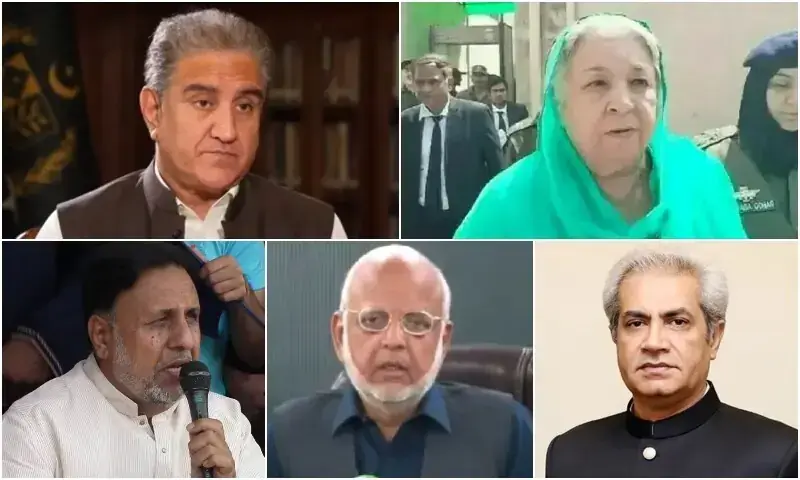

Five senior PTI leaders incarcerated at Lahore’s Kot Lakhpat on Wednesday opposed any change in the voting age, asking whether those “operating in the dark” were afraid of the youth’s power.
Shah Mahmood Qureshi, Dr Yasmin Rashid, Ejaz Chaudhry, Mian Mahmoodur Rasheed and Omar Sarfraz Cheema made the remarks in a letter sent through their advocate.
The development comes as debate has been raging in the country on raising the voting age from 18 to 25, with the topic also being discussed on TV shows. It is worth mentioning that no formal bill has been tabled in parliament for raising the voting age in Pakistan.
A column published in media on Wednesday also stated that “well-connected people” were floating the idea of raising the voting age to 25 as a possible reform.
In the letter, seen by media, the PTI leaders said Pakistan had witnessed its first general elections in 1970, when the voting age was 21 years. However, with the advent of the 21st century, the world transformed into a global village because of which any incident anywhere in the world could be seen in “real time”.
They said that Pakistan too realized that the voting age limit should be reduced from 21 years to 18 years. And no segment of society objected to it, they added.
They said that since the government had set the age for obtaining a national identity card and getting married at 18 years, there was no justification for increasing the voting age.
“Is this mindset suggestive of fear of the power of the youth and distrust of their conscience?” they asked in the letter.
They said that in the past, a reform was introduced for graduation being compulsory for contesting elections, which had be withdrawn later.
They added that the youth’s insight, perception, decision-power and collective wisdom were the nation’s assets and could be used to do wonders in the country.
The jailed leaders warned that the youth would not let the wheel of history move backwards and would fight against the “fear-driven mindset”.
The PTI leaders hoped that all political parties in the country, particularly the PML-N and the PPP, would not support any fear-driven mindset to suppressthe the youth’s right to vote.
In recent days, social media has been abuzz with commentary noting that since Pakistan’s electorate is primarily between the ages of 18 and 25, any change in the voting age would significantly alter the voter base.
The opposition voices and analysts also argue that such a move would amount to youth disenfranchisement rather than reform.
Commentators on social media have also pointed out that raising the voting age would require a constitutional amendment, which requires a two-thirds majority in Parliament.





 American Dollar Exchange Rate