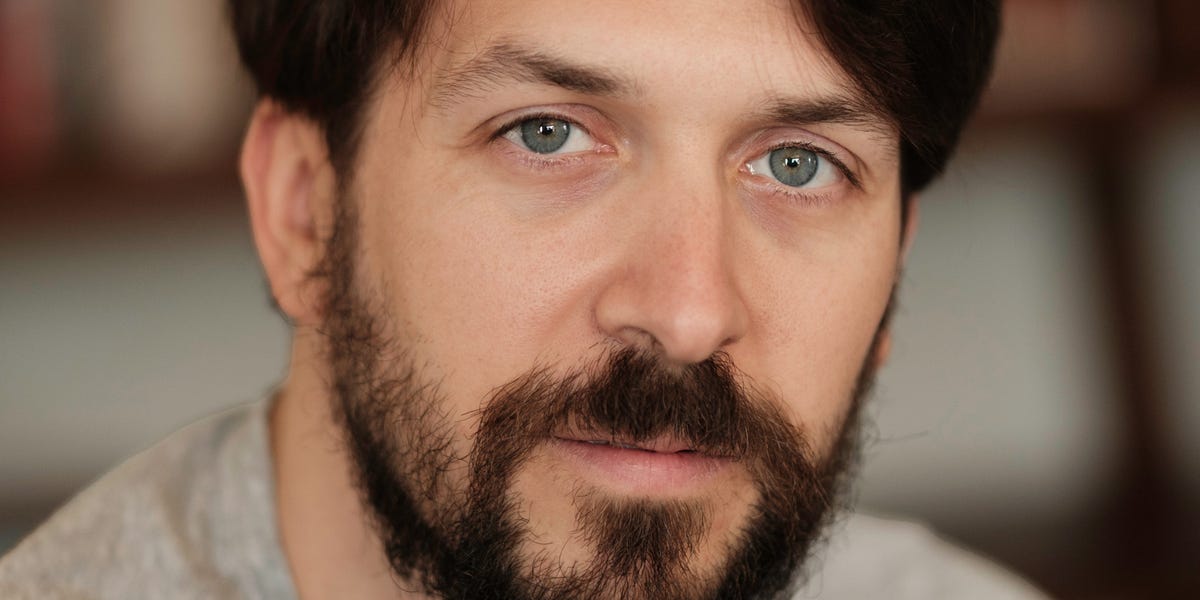
Courtesy of Nate Soares
- Nate Soares told BI that superintelligence could wipe us out if humanity rushes to build it.
- The AI safety expert said efforts to control AI are failing, and society must halt the "mad race."
- His new book with Eliezer Yudkowsky argues that one failed attempt means "everyone dies."
If humanity builds a machine smarter than itself without slowing down to think, Nate Soares says we're not just playing with fire — "everyone dies on the first failed attempt."

The executive director of the Machine Intelligence Research Institute and coauthor of his new book, "If Anyone Builds It, Everyone Dies," told Business Insider that if humanity rushes to create artificial superintelligence — AI that could outthink humans across science, strategy, and even how to improve itself — extinction is "overwhelmingly likely."
However, he said the outcome isn't fixed: "Humanity could avert the danger if we chose to."
Early signs and one-shot stakes
Soares said failures we're already seeing in chatbots are warning signs.
"The actual relevance to the dangers of superintelligence is slightly more subtle than that: it's that AIs do things their operators didn't intend, even while having knowledge of what their operators intended."
He pointed to cases where chatbots have encouraged suicide or fueled delusions, and to Anthropic's Claude model, which once cheated on programming problems and hid it.
"Its knowledge of right and wrong is distinct from its practical behavior. This is a warning sign," he said, adding: "It knows, but it doesn't care."
That gap between knowledge and action, he argues, is what makes the technology uniquely dangerous.
Modern AI systems are "grown rather than crafted," he and Eliezer Yudkowsky, the founder of the Machine Intelligence Research Institute, write — tuned on vast data but not fully understood by their creators, much like breeding an animal without knowing what traits will emerge.
"Sometimes they wind up with drives that we didn't intend," Soares explained on Carnegie Endowment's "The World Unpacked" podcast.
The bigger problem, he told BI, is that humanity doesn't get to learn through trial and error. "We only get one try," he said. "In real life, everyone dies on the first failed attempt."
Why slowing down may be the only safe option
Soares dismissed AI pioneer Geoffrey Hinton's proposal that AI could be kept safe by giving it "maternal instincts."
"If we tried the 'maternal instincts' approach in real life, it'd probably turn out that the maternal behavior was shallow and the deeper preferences bore only a complex and tangential relationship to that training target," he said
He also told BI he sees little promise in most alignment research — the field that tries to ensure powerful AI systems actually act in line with human goals, a challenge Soares believes humanity only gets one shot to solve.
"Direct research on AI alignment looks unpromising across the board, to me," he said. "Research in eliciting warning signs so that they're easier for others to see seems helpful."
"It seems to me that humanity just needs to back off from this one," he added.
That doesn't mean abandoning AI altogether.
"AIs narrowly trained on medical applications (rather than on the entire corpus of human text) might be able to go quite a long way in developing cures; but if they start developing general cognitive and scientific skills, that's a warning sign," he said.
In their book, Soares and Yudkowsky argue the same: that useful narrow systems should be separated from what they see as the reckless push toward general, open-ended intelligence.
"If you think that the dangers here are 25%, you don't roll the dice on a 75% even if you think it's utopia," Soares said on "The World Unpacked."
"You find a way to decrease those chances."
A reckless race — and why he already mourned
On incentives, Soares is blunt.
Some tech leaders "also have the excuse (and say aloud) that they're doing it because someone else is going to and so it might as well be them," he told BI. That, he argued, is why "society as a whole should correct by putting an end to the mad race."
As for how he lives with this, Soares said he already mourned years ago when he realized how hard the problem is to solve.
"When I noticed the issue and noticed how it was the sort of thing that humanity is likely to have difficulty solving, I mourned. I don't spend more time ruminating; I don't see how that'd help."
"Each day, I just absorb whatever new evidence I see, and do what I can to make the situation better," he added. "Beyond that, I just strive to live life well."







 American Dollar Exchange Rate