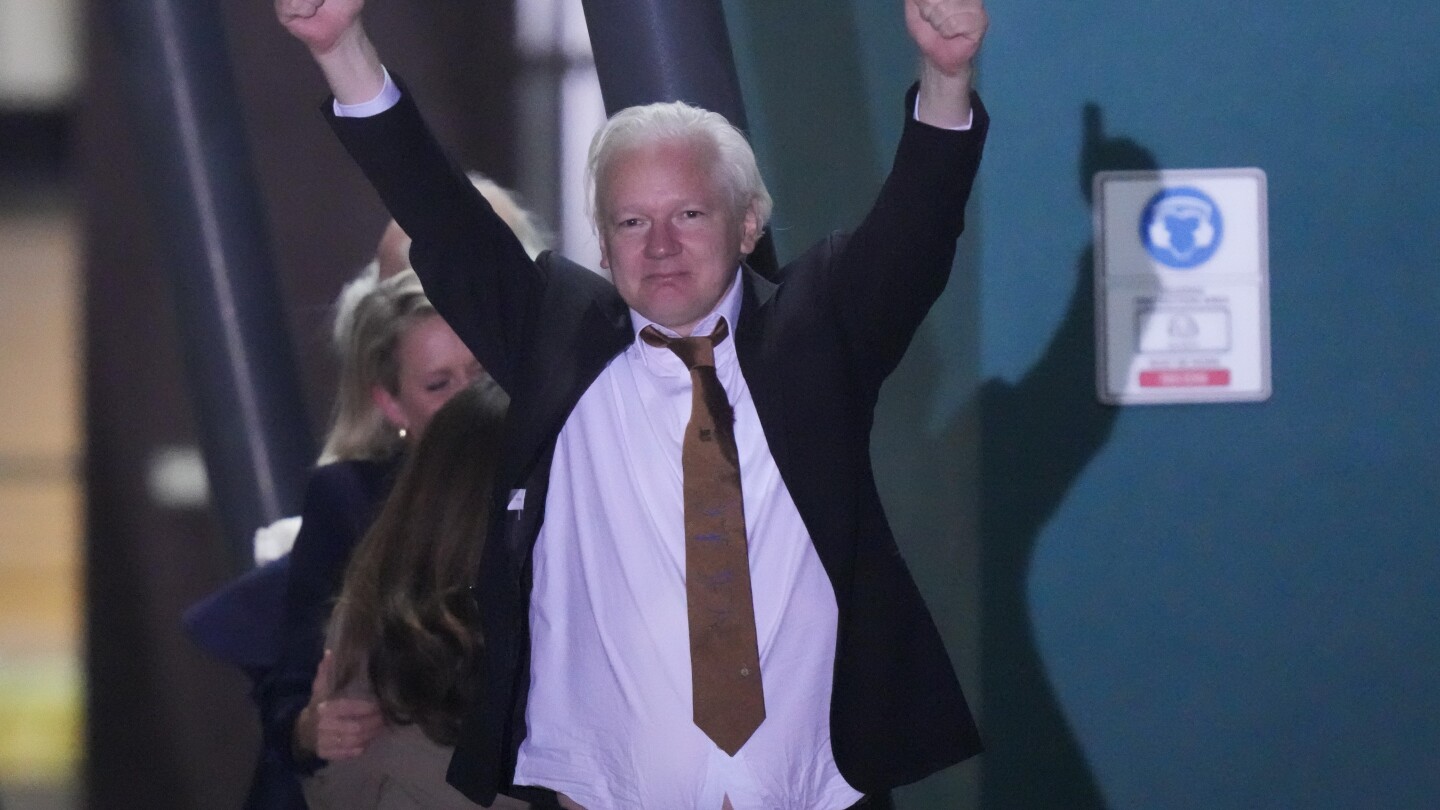
WASHINGTON (news agencies) — About a year and a half ago, a lawyer for Julian Assange presented federal prosecutors in Virginia with a longshot request: Dismiss the case against the WikiLeaks founder.

It was a bold ask given that Assange had published hundreds of thousands of secret documents and was arguably the highest-profile detainee in the world facing a U.S. government extradition request. By that point, the Justice Department had been engaged in a protracted fight in British courts to send him to the United States for trial.
Yet from that request, recounted by a person familiar with the matter, were the seeds that led to Wednesday’s unthinkable moment: Assange stepping out of a U.S. courthouse on a remote Western Pacific island, beginning his journey home after being holed up in self-exile and prison for a dozen years.
“How does it feel to be a free man, Mr. Assange?” someone shouted.
He smiled and nodded and kept walking. There was another flight to catch to take him home to Australia.
The plea deal unfolded against the backdrop of a plodding extradition process that produced no guarantee the self-styled free speech advocate would ever be transferred for prosecution and a recognition by U.S. officials of the more than five years he’d already served in a British prison. By the end, a series of proposals and counterproposals were made to resolve points of division: the Justice Department’s desire for a felony guilty plea and Assange’s refusal to step foot in the continental U.S., where he envisioned any number of potential cataclysmic scenarios for himself.
The agreement also included safety valves that would ensure Assange’s liberty in Australia in the unlikely event a judge rejected it at the last minute.
This report is based on interviews with people familiar with the negotiations and overall case who spoke with media on condition of anonymity to discuss the process, as well as a review of court records.
Assange’s release in the unlikely location of Saipan, the capital of the Northern Mariana Islands, concluded a polarizing legal saga that spanned three presidential administrations and multiple continents.
It would have been unthinkable five years ago.
That’s when the Justice Department unsealed charges as British authorities hauled a bearded and shouting Assange from the Ecuadorian Embassy where he’d been holed up for the prior seven years. Assange took refuge in 2012 after being released on bail while facing extradition to Sweden on sexual assault allegations that were later dropped.
He remained there, fearing arrest and extradition to the U.S. in connection with the receipt and publication by WikiLeaks of hundreds of thousands of war logs and diplomatic cables that American prosecutors say he conspired with Army intelligence analyst Chelsea Manning to illegally obtain.
At the time of his indictment, Assange was perhaps better well-known for WikiLeaks’ involvement in the 2016 U.S. presidential contest when the secret-spilling website released tranches of damaging emails about Democratic presidential nominee Hillary Clinton that were stolen by Russian military intelligence officers in what officials said was brazen election interference by Moscow.
The releases prompted Trump to memorably proclaim during the campaign: “WikiLeaks, I love WikiLeaks.”
The view was different inside the Justice Department that Trump would soon lead. Attorney General Jeff Sessions in 2017 called the arrest of Assange a priority amid a crackdown on leaks of classified information.
The crime at issue wasn’t the hack-and-dump election interference but the diplomatic cables from years earlier. The Obama administration had had extensive debate about charging Assange but did not pursue an indictment under the Espionage Act — which criminalizes the mishandling of national defense information — in part over concerns it could be viewed as an attack on journalism.
But the Justice Department in the Trump administration took a different tack. The existence of a criminal case was inadvertently revealed by a filing error in 2018. The first narrowly tailored charge to be unsealed months later was a computer intrusion count that accused him of conspiring with Manning to crack a password that gave her higher-level access to classified computer networks.
Within weeks, the department disclosed 17 other counts that accused him of violating the Espionage Act by obtaining and disseminating the secret records.
Prosecutors say he crossed the line by soliciting the hacking of computer networks for classified information and by indiscriminately publishing secrets, including the unredacted names of sources who provided information to U.S. military forces. Assange’s supporters have for years maintained that he provided an invaluable public service by exposing military misconduct in America’s foreign wars, much the same way journalists are tasked with doing.
The case wasn’t easy legally. It also had logistical complications.



 American Dollar Exchange Rate