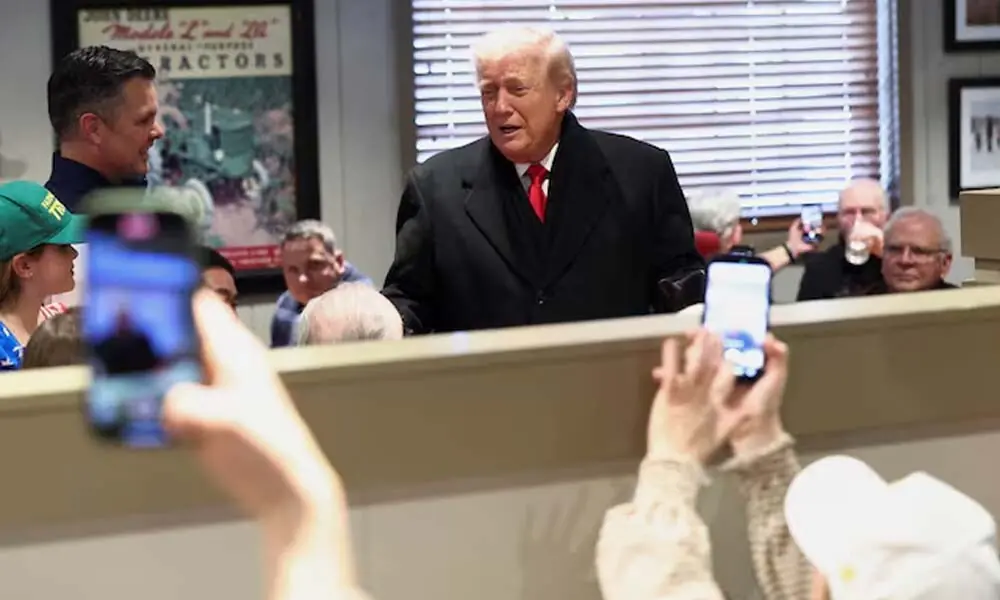

CLIVE, Iowa: U.S. President Donald Trump rallied supporters in Iowa on Tuesday as he worked to shore up support in a Midwestern political battleground just south of neighboring Minnesota, where a confrontation was escalating over the aggressive tactics of federal immigration agents.
The Republican president traveled to Iowa to rally his stalwart rural supporters in a state that hosts key congressional races in November.
Mounting stress in the farm economy and delays in biofuel policy are testing the patience of farmers and renewable-fuel producers.
READ MORE: Trump in trouble on immigration, as signature issue turns deadly
While Trump tries to convince voters he is bringing costs down, his White House is embroiled in a crisis in neighboring Minnesota.
On Saturday, federal immigration agents shot and killed 37-year-old U.S. citizen Alex Pretti during a protest in Minneapolis, sparking widespread demonstrations and calls for independent investigations.
Pretti was the second American to be fatally shot by federal immigration officers this month in Minneapolis, where Trump has deployed thousands of armed and masked agents.
“Our border is closed, totally closed,” Trump said, to cheers, in defense of his immigration policies.
In largely rural Iowa, concerns about affordability are mixed with growing anxiety over weak crop prices and high costs for fertilizers, farm equipment and other inputs. These worries, along with uncertainty about Trump’s policies on biofuels and trade with China, threaten to erode his support across the U.S. farm belt. Iowa is the nation’s largest producer of corn, hogs and ethanol.
“If they won, this country would be cratering,” Trump said of Democrats. “I made a lot of people rich that I don’t even like,” Trump said, touting high stock prices.
A visit to the rural heartland
Trump won Iowa in each of the last three presidential elections. Some of the rural voters who were his most loyal supporters are now struggling to make ends meet.
Like many farmers, 56-year-old Iowa corn and cattle farmer Lance Lillibridge said he has been hit hard by a trade war with China and rising costs of seeds and fertilizer, and he hopes the administration will pursue another multibillion-dollar farm bailout.
“Right now everything’s just terrible; I’ve never been so cash poor in my entire life,” Lillibridge said, describing himself as a Trump supporter “for the most part.”
Even as Trump made his case on the economy, the U.S. dollar sank to a near four-year low against a basket of currencies, with traders on Tuesday citing concerns including the prospect of another U.S. government shutdown, White House intervention in central bank policy and Trump’s ongoing tariff threats.
“On the economy, they don’t have a plan; there’s nothing to announce,” said Michael Strain, director of economic policy studies at the conservative American Enterprise Institute think tank. “They’re not going to roll back tariffs, they’re not going to say we’re going to reduce the deficit. They’re not going to say that attacking the Fed is counterproductive and puts upward pressure on inflation, and they don’t have a plan to make housing more affordable.”
A Reuters/Ipsos poll that closed on Sunday showed that 30% of Americans approved of Trump’s handling of the rising cost of living, while 59% disapproved, including nine in 10 Democrats and one in five Republicans.
Trump’s Republicans are defending narrow congressional majorities in November’s midterm elections, when incumbent presidents’ parties typically lose seats.
Iowa will host two highly competitive races for U.S. House of Representatives seats held by Republican Representatives Mariannette Miller-Meeks and Zach Nunn.
Difficulty in the U.S. Farm business
Strain in the U.S. farm economy has been mushrooming, from unsold tractors to agribusiness companies reporting shrinking earnings. Abundant grain supplies have weighed on markets, while production costs remain high, leaving crop prices weak for a third straight year.
Also stressing farmers, the administration has delayed final biofuel-blending quotas for 2026. The quotas are known as renewable volume obligations, or RVOs.
It has also not finalized tax guidance for renewable-fuel credits known as 45Z, and efforts have stalled on a long-standing priority for corn growers: securing congressional approval for year-round sales of gasoline blended with 15% ethanol.
Those delays have hit Iowa’s biodiesel industry particularly hard. Iowa’s biodiesel plants produced 244 million gallons in 2025, down 31% from 2024, the Iowa Renewable Fuels Association said. At full capacity, the state’s plants can produce more than 400 million gallons a year.
Trump on Tuesday said congressional leaders are working on legislation to allow gasoline blends containing 15% ethanol. “They are very close to getting it done,” he said.
Scott Irwin, an agricultural economist at the University of Illinois, said that while Trump’s trade policies have hurt crop farmers, the administration has eased regulations and kept fuel prices lower to maintain support.
“As long as Trump and a Republican Congress are willing to backfill a significant amount of crop losses with special programs, his support will remain solid,” Irwin said.





 American Dollar Exchange Rate