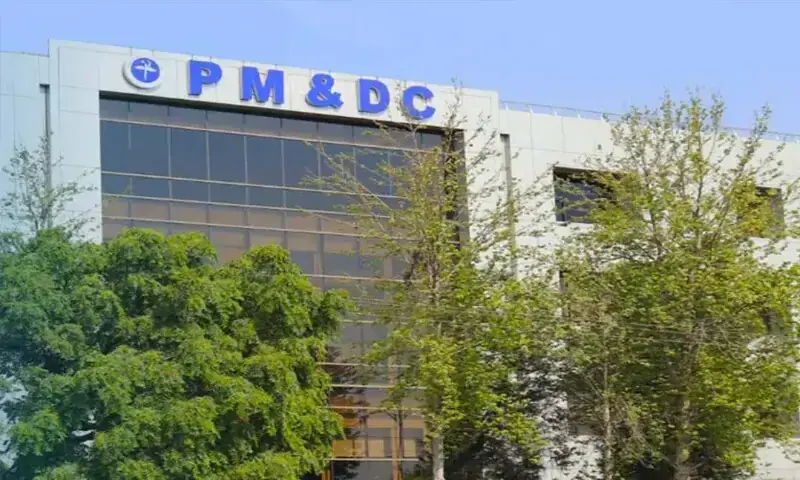

ISLAMABAD: The Pakistan Medical and Dental Council announced on Wednesday that universities may allow a one-time reduction of up to three per cent in the Medical and Dental College Admission Test (MDCAT) passing percentage for admissions to medical and dental colleges to fill vacant seats for the academic session 2025–26.
A notification issued by the PMDC, which is available with media, said the decision had been made on the recommendation of a parliamentary committee.
The notification said: “To address the issue of vacant seats in MBBS (Bachelor of Medicine, Bachelor of Surgery) and BDS (Bachelor of Dental Surgery) programmes fairly and systematically, the matter, after deliberation at the national level, including the Health Standing Committees, has been thoroughly reviewed by the PMDC Council.
“Accordingly, it has been decided that any admissions or processes already completed under the Admission Regulations 2025 shall remain valid and shall be treated as properly regulated.”
It added that universities that already had a pool of eligible students for MBBS and BDS programme under the previously announced criteria must give priority to those students when filling vacant seats, especially in private medical and dental institutions.
“If seats remain vacant after all students in the existing pool have been considered, and the admitting universities are satisfied that no more eligible students are available, they may allow a one-time reduction of up to three per cent in the MDCAT (Medical and Dental College Admission Test) passing percentage for both MBBS and BDS admissions (i.e., MBBS: 52pc and BDS: 47pc) for the financial stability of the institutions,” it stated.
The notification further stated that the decision had been made to fill only the vacant seats for the academic session 2025–26, “ensuring strict merit-based transparency and institutional accountability by the admitting universities and monitoring the admission process by the admitting universities for the vacant seats”.
“Furthermore, private institutions are strongly encouraged to consider a reduction in tuition fees from the currently notified/capped structure to enhance affordability and facilitate access to medical and dental education for meritorious students.
“The last date for admissions is April 15, 2026. All provincial health departments and admitting universities must ensure full compliance with these instructions. Any violation shall be dealt with under applicable laws and regulations,” it added.
A faculty member of a university, wishing not to be named, told media that during the last few years, PMDC had twice reduced the minimum percentage for MDCAT.
“Once, candidates with marks below 60pc in MDCAT were considered to have failed the test. Later, the percentage was reduced to 55pc for MBBS. On the other hand, it was further reduced to 50pc for BDS candidates, and now the percentage has been reduced by further 3pc”, he added.
He said candidates could not even get admission to nursing colleges with such low percentages. “But here, candidates have been allowed to become doctors.”
The faculty member claimed the decision had been taken to facilitate private medical colleges, adding, however, that it would “only further deteriorate the quality of education and damage the image of Pakistani doctors at the international level”.
A father of a student, who also wished not to be named, said that the PMDC had been claiming that the decision had been made on the recommendations of a parliamentary committee.
“The parliamentary committee had also directed the PMDC to ensure that colleges did not receive high fees from students who were enrolled in the 2023-24 academic year, but colleges have been charging Rs2.5-2.9 million from them,” he pointed out.
On the other hand, the “PMDC is mum over it as any action will affect the private colleges”, he alleged.
For the ongoing year, the tuition fee, inclusive of all ancillary charges, was capped at Rs1.89 million with a five per cent increase.
The PMDC spokesperson, in a written response on that matter, stated: “All recommendations are duly considered and welcomed. All the recommendations are placed before the council for approval. No design is finalised without prior approval of the council.”






 American Dollar Exchange Rate