Mark Adam Miller
Greenland has no shortage of valuable minerals. What it lacks is almost everything else needed to extract them.

Greenland is one of the most logistically hostile environments on the planet — a place with no roads between towns, limited labor, and weather that can shut down operations without warning.
Still, world leaders and investors across the globe have their eyes on the island for its natural resources, including copper, zinc, graphite, gold, and rare earth elements that can be used in everything from construction and manufacturing to electronics and defense systems.
As the US, Europe, and other countries look to diversify supply chains away from China, Greenland has drawn renewed attention as a potential alternative. President Donald Trump's latest remarks that the US should annex Greenland for national security reasons — triggering an outcry from its citizens — have also drawn attention to the island and its strategic value.

Mark Adam Miller
There is only one fully operational mine in Greenland. Business Insider's Sarah Andersen visited the mine in June to see why it remains open while others have shut down — and why the island's vast mineral wealth hasn't translated into a mining boom.
What it takes to run a mine in Greenland
You always have to plan several steps ahead when operating in Greenland, said Bent Olsvig Jensen, managing director of Lumina Sustainable Materials.

Mark Adam Miller
"We have to think of everything because we cannot just pick up the phone and expect spare parts to be available the next morning," he said in June.
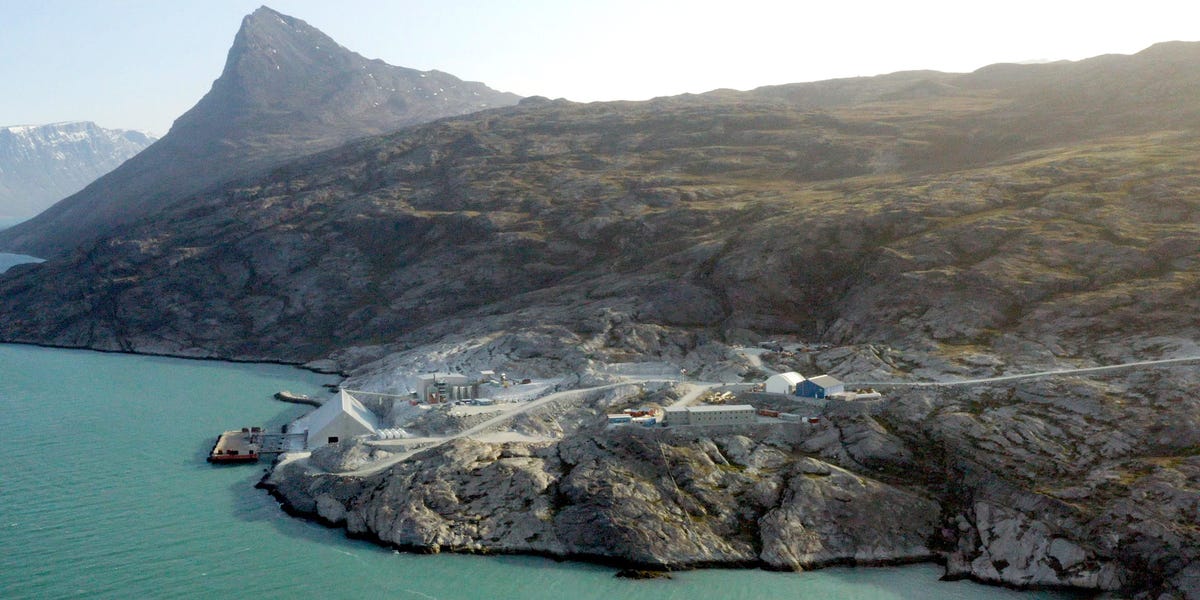
Lumina Sustainable Materials — a private science and mining company group with operations in Greenland, the US, Mexico, and the European Union — operates the island's only fully active mine, located deep inside a fjord system with no road access.
The mine produces an industrial mineral called anorthosite, used in fiberglass, construction materials, and other industrial applications.
Mark Adam Miller
Aside from what they've built, which includes a camp, a plant, a warehouse, a harbor, and a small gym and clinic, there is no other infrastructure supporting the site. Everything, including the crew, arrives by ship during the ice-free months or by helicopter when the fjord freezes over for months on end, Jensen said. (Andersen arrived via an eight-hour boat trip from the capital, Nuuk.)
When something breaks, there is no overnight delivery.
"Sometimes you can wait for spare parts for a week or two," Dennis Jensen (no relation to Bent Jensen) said during Andersen's visit to the mine. Jensen is the mine's site manager who oversees operations through the long, dark winters, where temperatures can dip to -22°F. When that happens, "we are not working outside," he said.
Mark Adam Miller
Winter storms can ground helicopters for days, delaying crew changes and keeping workers on-site longer than planned, Dennis Jensen added.
Why Greenland mining projects are so difficult to get off the ground
On average, "it takes 16 years to develop a mine, right from the first idea to the actual mine," Naaja Nathanielsen, Greenland's minister responsible for natural resources, including minerals, said in June.
For most of that time, "you spend money, you don't make a lot of money," she said.
Mark Adam Miller
It took Lumina 11 years, for example, to get from exploration to production. Exploration started in 2008 and reached final production in 2019, Bent said.
Greenland has over 100 mineral licenses, spanning early exploration to advanced stages. Many projects stall long before reaching operation, often because they cannot secure long-term financing, Nathanielsen said.
People mistakenly think they can begin to extract the minerals on day one, but they can't, Majken Djurhuus Poulsen, a geologist with the Geological Survey of Denmark and Greenland, told Andersen during her visit.
Mark Adam Miller
Parts of Greenland host some of the oldest bedrock on the planet, billions of years old, Poulsen said. That history has created many different types of mineral deposits, but the conditions make exploration slow.
"You can only do exploration for three to four months a year," when areas are ice-free enough, she added.
On top of that, Poulsen said sites can be difficult to get to, often requiring helicopters that push costs higher. There's rarely any infrastructure, so you have to build everything from scratch — from the mine to where workers will live. After all that, identifying a promising deposit can take years, sometimes decades, she added.
Mark Adam Miller
As a result, mining requires investors who are willing to wait years without returns and have a high tolerance for risk. Nathanielsen said Greenland lacks the domestic capital to fund that process and depends heavily on foreign investment.
"It is quite sobering in terms of trying to keep your providers of capital," James Kiernan, honorary chairman of Cordiant Capital, a Canadian multinational investment management firm and one of Lumina's major backing investors, told Andersen in July.
Mark Adam Miller
Kiernan pointed to multiple examples of mines affected as market realities shifted.
"There was a mine called Ruby that was open, and they were trying to find rubies. They were open and closed and open and closed," he said, referring to the Greenland Ruby mine and describing the stop-start pattern that has defined many efforts on the island.
'One mine at a time'
At the same time, the government has kept strict environmental and social standards.
Before any project moves forward, Nathanielsen said companies must answer two questions: Will it create jobs for Greenlanders, and how will it protect the environment?
"If the project owners cannot answer those two questions on a satisfactory level, if they cannot provide the people with a good answer, they will meet opposition," she said.
Mark Adam Miller
Lumina's success in navigating that process is in part due to its long planning horizons, close coordination with the government, and a business model designed around Greenland's constraints.
Still, the mine has yet to turn a profit, Kiernan told Andersen during a follow-up call on Friday.
But Bent Jensen and Kiernan said that after years of operating in Greenland's challenging conditions, the company is well-positioned to apply that know-how to other mining projects, and Lumina has recently secured an exploration license to search for rare earth minerals.
More mines could unlock a new future for Greenlanders, helping pave a path toward greater autonomy as the island seeks to develop new revenue streams to eventually become financially independent from Denmark.
However, a mining boom isn't likely at any point soon, Bent Jensen said.
"I see Greenland developing slowly because it needs to develop organically with the population, with the politicians," he said. "It will be one mine at a time."






 American Dollar Exchange Rate