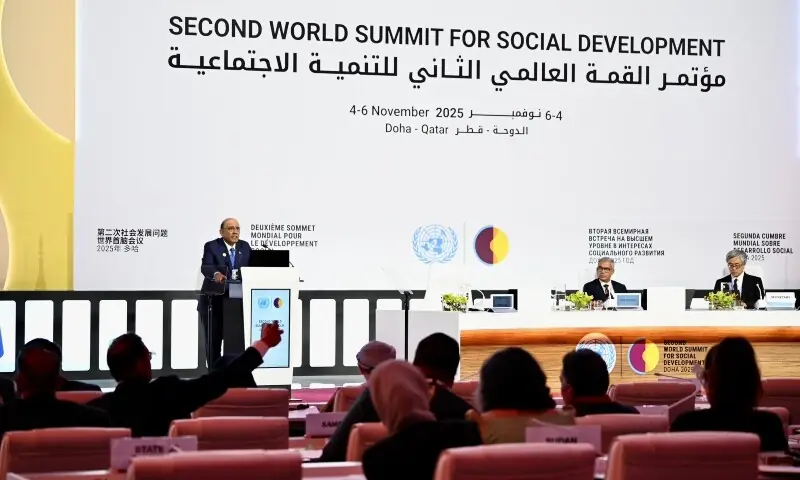

President Asif Ali Zardari said on Tuesday that the violation of the Indus Waters Treaty (IWT) by India could not and would not succeed, and warned against the weaponisation of water.
India in April held the IWT in abeyance following the attack in occupied Kashmir’s Pahalgam that killed 26 — an incident New Delhi blamed on Islamabad without evidence. Pakistan termed any attempt to suspend its water share an “act of war”, noting the IWT had no provision for unilateral suspension. It later said it was considering court action, citing a violation of the 1969 Vienna Convention on the Law of Treaties.
President Zardari addressed the issue while speaking at the Second World Summit for Social Development in Doha, Qatar today, saying: “We in Pakistan, on one hand, face the brunt of the impact of climate change, which has caused devastation for our people in the form of large-scale floods … on the other hand, we face a new threat in the form of water weaponisation. Water, which all the world knows, is an equal right of any human being and humanity.”
“We are being threatened from across the border with a new threat in the form of weaponisation of water, violation of the IWT. This poses a serious threat to 240 million Pakistanis. Such tactics cannot and will not succeed.”
A supplemental award by the Permanent Court of Arbitration (PCA) in The Hague in June held that India could not unilaterally hold the treaty in abeyance. India, in response, said it did not recognise the court or its decisions.
Under the 1960 IWT, three rivers that flow westwards were awarded to Pakistan, with India getting three eastern-flowing rivers. In 2023, Pakistan brought a case to the PCA over the design of Indian hydropower projects on rivers that were awarded to Pakistan under the treaty. The court, in its August ruling in the case, said it had jurisdiction over the dispute and ruled the treaty “does not permit India to generate hydro-electric power on the Western Rivers based on what might be the ideal or best practices approach for engineering” of these projects. Instead, the design of these projects must adhere “strictly” to the specifications laid down in the treaty, the court said, adding that India must generally “let flow” the waters of the western rivers for Pakistan’s “unrestricted use”.
The president also reaffirmed Pakistan’s commitment to social justice, inclusive development and global solidarity, emphasising the need to eradicate poverty, promote decent work and ensure equality and human rights for all.
The president expressed full support for the Doha Political Declaration and highlighted that the country’s vision for inclusiveness and sustainable development aligned with the spirit of the declaration.
“Pakistan remains steadfast in placing people at the centre of policy,” President Zardari added.
Showcasing Pakistan’s progress, he cited the Benazir Income Support Programme (BISP), which he said had empowered over nine million families through income assistance, healthcare and education. The initiative, he said, was recognised globally as one of the best social protection models.
He also reaffirmed the country’s commitment to the Sustainable Development Goals, pledging to raise literacy to 90 per cent and ensure every child attended school within five years.
The president also mentioned initiatives such as the National Youth Internship Programme and green and resilient housing projects, which aim to empower young people and strengthen climate resilience through nature-based solutions, including mangrove restoration.
Outlining a roadmap to translate the Doha Declaration into action, Zardari urged the world to unite around three pillars: dignity, equality and solidarity, emphasising global financial reforms, debt relief, equitable taxation and expanded social protection.
Condemning the “genocide, apartheid, and mass starvation” in Palestine, the president also called for a just and lasting peace.
The president also reiterated Pakistan’s unwavering support for the people of Kashmir, linking both struggles as two sides of the same coin in the pursuit of justice and self-determination.
“Development must begin and end with the betterment of people,” President Zardari said, adding that “we must rise above all differences to embark on a path of compassion and progress for all.”
Meetings with Iraqi, Tajik counterparts
Zardari also met Iraqi counterpart Dr Abdul Latif Jamal Rashid, both reviewing the entire spectrum of bilateral relations and reaffirming their mutual commitment to further strengthening longstanding ties.
Discussing trade and investment, both sides underlined the importance of enhancing economic linkages through increased business-to-business interactions and facilitative visa regimes.
President Zardari appreciated Iraq’s cooperation in facilitating Pakistani pilgrims and acknowledged the valuable contribution of the Pakistani community in Iraq, which served as a bridge of goodwill between the two nations.
The two leaders also exchanged views on regional peace, stability and cooperation, agreeing to maintain regular high-level contacts to advance bilateral relations.
The Iraqi president again invited President Zardari to visit Iraq.
The president accepted the invitation and stated that he would undertake the visit soon after the Iraqi parliamentary elections, scheduled for later this month.
He also reaffirmed Pakistan’s commitment to further strengthening bilateral cooperation in trade, investment, connectivity, energy, defence and people-to-people exchanges with Tajikistan.
President Zardari said that Pakistan greatly valued its multifaceted relationship with Tajikistan, rooted in shared history, culture, and linguistic affinity.
He noted that the Strategic Partnership Agreement signed in 2024 reflected the growing depth of ties between the two countries. He welcomed the resumption of work on the CASA-1000 project, terming it a flagship initiative for shared prosperity, and invited Tajikistan to explore new avenues of trade and connectivity through Pakistan, including the possibility of restoring direct flights.
President Zardari also commended the successful Dosti-II joint military exercise held in August 2025 and reaffirmed Pakistan’s readiness to assist Tajikistan in defence cooperation and capacity building.
The Tajik president invited Zardari to visit the country, which the latter accepted.
The two leaders also shared perspectives on regional and global issues of common concern.
The president also met the UN chief and reaffirmed Pakistan’s support for multilateralism, highlighted BISP’s role in social inclusion and called for peaceful resolutions of the Kashmir and Palestine disputes.



 American Dollar Exchange Rate