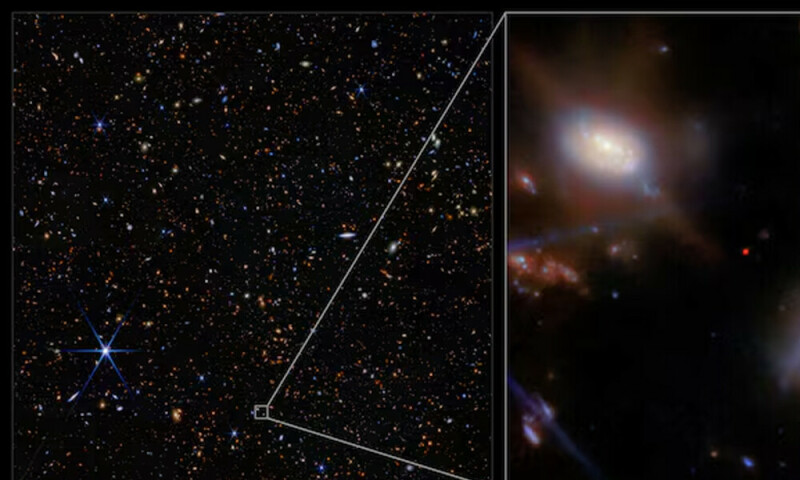

WASHINGTON: Scientists using the James Webb Space Telescope have identified an ancient and faraway galaxy that provides evidence that an important transition period that brought the early universe out of its “dark ages” occurred sooner than previously thought.
Webb, which by peering across vast cosmic distances is looking way back in time, observed the galaxy called JADES-GS-z13-1 as it existed about 330 million years after the Big Bang event that initiated the universe roughly 13.8 billion years ago, the researchers said.
By way of comparison, Earth is about 4.5 billion years old.
The universe is thought to have experienced a rapid and exponential expansion in a fraction of a second after the Big Bang.
After having cooled down sufficiently, there was a period called the cosmic dark ages when the infant universe was enveloped in a dense fog of hydrogen gas in an electrically neutral state.
What followed that was a time called the epoch of reionization when the universe first began to shine.
Webb obtained evidence that JADES-GS-z13-1, one of the earliest-known galaxies, had made the transition into this epoch.
“In JADES-GS-z13-1, Webb has confirmed one of the most distant galaxies known to date,” said astrophysicist Joris Witstok of the University of Copenhagen’s Cosmic Dawn Center and the Niels Bohr Institute, lead author of the study published in the journal Nature.
“Unlike any other similarly distant galaxy, it shows a very clear, telltale signature that suggests the galaxy contains a remarkably powerful source of energetic ultraviolet radiation and has made an unexpectedly early start to reionization,” Witstok said.
The time when the universe’s first stars, black holes and galaxies formed is called cosmic dawn.
Euclid mission data release is step toward grand atlas of the cosmos
As these formed, the ultraviolet radiation they emitted chemically altered the neutral hydrogen gas in a process called reionization and allowed ultraviolet light to escape, effectively “turning on the lights” in the cosmos.
“The universe, after the Big Bang, was a soup of hydrogen, helium and dark matter, slowly cooling off. Eventually, the universe was in a state where it was entirely opaque to energetic ultraviolet radiation.
Hydrogen was floating around in a neutral state, meaning each little hydrogen atom had an electron bound to it,“ said astrophysicist and study co-author Kevin Hainline of the University of Arizona’s Steward Observatory.
“But as the first stars and galaxies started to form from this early universe gas, the ultraviolet radiation from young stars and from growing supermassive black holes began to knock electrons off of these neutral hydrogen atoms.
And over hundreds of millions of years the universe transitioned from being opaque to ultraviolet light to transparent to ultraviolet light, which is where we are now,“ Hainline said.
The researchers said the light that Webb detected in this galaxy may have come from vigorous star formation in the galaxy’s nucleus, the presence of a growing supermassive black hole at the galactic core that is violently consuming surrounding material or some combination of those two factors.
This galaxy measures about 230 light-years wide, several hundred times smaller than the Milky Way. A light-year is the distance light travels in a year, 5.9 trillion miles (9.5 trillion km).
Webb, which was launched by NASA in 2022 and became operational in 2023, has begun to provide a deeper understanding of the early universe. It has spotted only four galaxies dating to slightly earlier than this one, including the current record holder observed at 294 million years after the Big Bang.
Those galaxies have not displayed evidence of reionization.
The researchers were stunned to find that JADES-GS-z13-1 showed such evidence – in the form of a large bubble of ionized hydrogen surrounding it – because reionization was thought to have started many millions of years later.
“Many independent measurements have firmly established that reionization was not fully completed until the universe was about one billion years old – 700 million years later than this galaxy – placing this galaxy at what is likely the start of the reionization era.
When exactly it began is one of the big outstanding questions in cosmology,“ Witstok said.








 American Dollar Exchange Rate