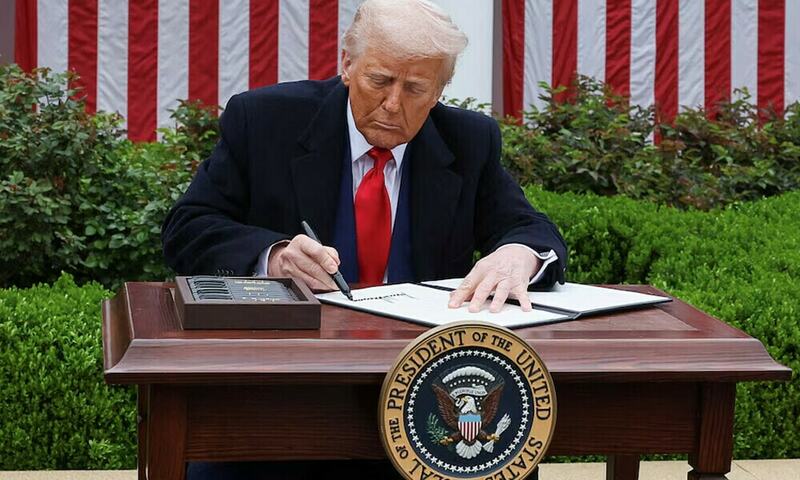
WASHINGTON: Global markets reeled Friday from President Donald Trump’s tariffs barrage against nearly all US trading partners as governments looked down the barrel of a seven day deadline before the higher duties take effect.
Trump announced late Thursday that dozens of economies, including the European Union, will face new tariff rates of between 10 and 41 percent.
However, implementation will be on August 7 rather than Friday as previously announced, the White House said. This gives governments a window to rush to strike bilateral deals with Washington setting more favourable conditions.
Neighbouring Canada, one of the biggest US trade partners, was hit with 35 percent levies, up from 25 percent, effective Friday — but with wide-ranging, current exemptions remaining in place.
The tariffs are a demonstration of raw economic power that Trump sees putting US exporters in a stronger position while encouraging domestic manufacturing by keeping out foreign imports.
But the muscular approach has raised fears of inflation and other economic fallout in the world’s biggest economy.
Stock markets in Hong Kong, London and New York slumped as they digested the turmoil.
Trump’s actions come as debate rages over how best to steer the US economy, with the Federal Reserve this week deciding to maintain interest rates unchanged, despite massive political pressure from the White House to cut.
Data Friday showed US job growth missing expectations for July, while unemployment ticked up to 4.2 percent from 4.1 percent.
On Wall Street, the S&P 500 dropped 1.7 percent, while the Nasdaq slumped 2.3 percent.
Trump raised duties on around 70 economies, from a current 10 percent level imposed in April when he unleashed “reciprocal” tariffs citing unfair trade practices.
The new, steeper levels listed in an executive order vary by trading partner. Any goods “transshipped” through other jurisdictions to avoid US duties would be hit with an additional 40-percent tariff, the order said.
But the tariffs also have a distinctly political flavor, with Trump using levies to try and get Brazil to drop the trial of his far-right ally, former president Jair Bolsonaro.
He also warned of trade consequences for Canada after Prime Minister Mark Carney announced plans to recognize a Palestinian state at the UN General Assembly in September.
Trump’s order cited Canada’s failure to “cooperate in curbing the ongoing flood of fentanyl and other illicit drugs” — although Canada is not a major source of illegal narcotics.
By contrast, Trump gave more time to Mexico, delaying for 90 days a threat to increase its tariffs from 25 percent to 30 percent.
But exemptions remain for a wide range of Canadian and Mexican goods entering the United States under an existing North American trade pact.
Carney said his government was “disappointed” with the latest rates hike but noted that with exclusions the US average tariff on Canadian goods remains one of the lowest among US trading partners.
With questions hanging over the effectiveness of bilateral trade deals already struck — including with the European Union and Japan — the outcome of Trump’s overall plan remains uncertain.
“No doubt about it — the executive order and related agreements concluded over the past few months tears up the trade rule book that has governed international trade since World War II,” said Wendy Cutler, senior vice president of the Asia Society Policy Institute.
“Whether our partners can preserve it without the United States is an open question,” she added.
Notably excluded from Friday’s drama was China, which is in the midst of negotiations with the United States.
Washington and Beijing at one point brought tit-for-tat tariffs to triple-digit levels, but both countries have agreed to temporarily lower these duties and are working to extend their truce.
Those who managed to strike deals with Washington to avert steeper threatened levies included Vietnam, Japan, Indonesia, the Philippines, South Korea and the European Union.
Among other tariff levels adjusted in Trump’s latest order, Switzerland now faces a higher 39 percent duty.

WASHINGTON: Global markets reeled Friday from President Donald Trump’s tariffs barrage against nearly all US trading partners as governments looked down the barrel of a seven day deadline before the higher duties take effect.
Trump announced late Thursday that dozens of economies, including the European Union, will face new tariff rates of between 10 and 41 percent.
However, implementation will be on August 7 rather than Friday as previously announced, the White House said. This gives governments a window to rush to strike bilateral deals with Washington setting more favourable conditions.
Neighbouring Canada, one of the biggest US trade partners, was hit with 35 percent levies, up from 25 percent, effective Friday — but with wide-ranging, current exemptions remaining in place.
The tariffs are a demonstration of raw economic power that Trump sees putting US exporters in a stronger position while encouraging domestic manufacturing by keeping out foreign imports.
But the muscular approach has raised fears of inflation and other economic fallout in the world’s biggest economy.
Stock markets in Hong Kong, London and New York slumped as they digested the turmoil.
Trump’s actions come as debate rages over how best to steer the US economy, with the Federal Reserve this week deciding to maintain interest rates unchanged, despite massive political pressure from the White House to cut.
Data Friday showed US job growth missing expectations for July, while unemployment ticked up to 4.2 percent from 4.1 percent.
On Wall Street, the S&P 500 dropped 1.7 percent, while the Nasdaq slumped 2.3 percent.
Trump raised duties on around 70 economies, from a current 10 percent level imposed in April when he unleashed “reciprocal” tariffs citing unfair trade practices.
The new, steeper levels listed in an executive order vary by trading partner. Any goods “transshipped” through other jurisdictions to avoid US duties would be hit with an additional 40-percent tariff, the order said.
But the tariffs also have a distinctly political flavor, with Trump using levies to try and get Brazil to drop the trial of his far-right ally, former president Jair Bolsonaro.
He also warned of trade consequences for Canada after Prime Minister Mark Carney announced plans to recognize a Palestinian state at the UN General Assembly in September.
Trump’s order cited Canada’s failure to “cooperate in curbing the ongoing flood of fentanyl and other illicit drugs” — although Canada is not a major source of illegal narcotics.
By contrast, Trump gave more time to Mexico, delaying for 90 days a threat to increase its tariffs from 25 percent to 30 percent.
But exemptions remain for a wide range of Canadian and Mexican goods entering the United States under an existing North American trade pact.
Carney said his government was “disappointed” with the latest rates hike but noted that with exclusions the US average tariff on Canadian goods remains one of the lowest among US trading partners.
With questions hanging over the effectiveness of bilateral trade deals already struck — including with the European Union and Japan — the outcome of Trump’s overall plan remains uncertain.
“No doubt about it — the executive order and related agreements concluded over the past few months tears up the trade rule book that has governed international trade since World War II,” said Wendy Cutler, senior vice president of the Asia Society Policy Institute.
“Whether our partners can preserve it without the United States is an open question,” she added.
Notably excluded from Friday’s drama was China, which is in the midst of negotiations with the United States.
Washington and Beijing at one point brought tit-for-tat tariffs to triple-digit levels, but both countries have agreed to temporarily lower these duties and are working to extend their truce.
Those who managed to strike deals with Washington to avert steeper threatened levies included Vietnam, Japan, Indonesia, the Philippines, South Korea and the European Union.
Among other tariff levels adjusted in Trump’s latest order, Switzerland now faces a higher 39 percent duty.






 American Dollar Exchange Rate