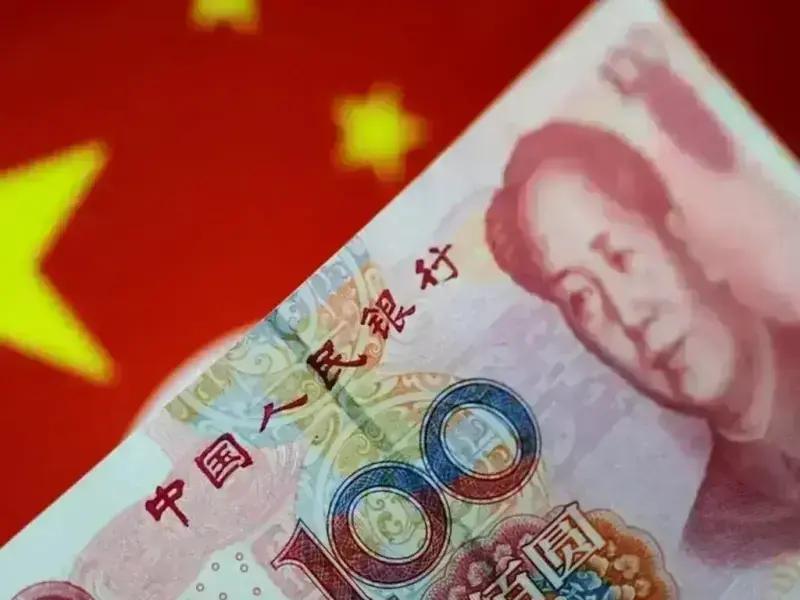

SHANGHAI: China’s yuan hit a near three-week high against the dollar on Friday, as the central bank continued to steer the currency stronger to stabilise the market ahead of a key policy meeting next week and amid escalating trade tensions with Washington.
The strength came as the central bank raised its daily guidance fixing for the third straight sessions to a fresh one-year high.
The guidance was much stronger than market projections, a move that investors interpreted as a policy preference for yuan stability.
Prior to the market opening, the People’s Bank of China (PBOC) set the midpoint rate at 7.0949 per dollar, its strongest since October 15, 2024 and 205 pips firmer than a Reuters’ estimate of 7.1154. The spot yuan is allowed to trade 2% either side of the fixed midpoint each day.
“Unlike in 2018-2019, when the yuan weakened post tariff announcements, USD/CNY has held remarkably steady in 2025, despite several rounds of tariff announcements,” analysts at Goldman Sachs said in a note.
“We think this indicates policymakers’ preference for currency stability and that it is unlikely to change in the near term.”
The yuan strengthened to a high of 7.1171 per dollar at one point, the strongest level since September 30, before parting gains. It was trading at 7.1236 as of 0332 GMT.
If it finishes the late night session at the midday level, it would post a weekly gain of 0.17% against the dollar and is up around 2.5% year-to-date.
Its offshore counterpart traded at 7.1257 per dollar, down about 0.01% in Asian trade on Friday.
Beijing and Washington have once again imposed tit-for-tat measures amid intensifying trade tensions. China announced it would increase rare earth export controls and US President Donald Trump threatened to raise tariffs on Chinese goods to 100% and tighten software export curbs from November 1.
China on Thursday accused the US of stoking panic over its rare earth controls and said Treasury Secretary Scott Bessent had made “grossly distorted” remarks about a top Chinese trade negotiator, rejecting a White House call to roll back the curbs.
“In our view, the most likely scenario is a de-escalation of tensions, allowing the Xi-Trump meeting to proceed as scheduled on October 31,” Larry Hu, chief China economist at Macquarie, said in a note this week.
“That said, a grand deal remains elusive and a lack of mutual trust persists, sowing the seeds for future escalations.”
Separately, market attention is shifting to China’s third-quarter gross domestic product (GDP) and other activity indicators on Monday and the conference of the Central Committee of China’s Communist Party.
The Fourth Plenum, from October 20 to 23, will outline the government’s economic, political and social agenda as well as its development plans for the next five years.
Investors are keen for news on Beijing’s plans for high-tech manufacturing, efforts to spur weak household consumption and how it will rein in industrial overcapacity.
The PBOC typically tends to keep a firm grip on the yuan during politically sensitive events.
A Reuters poll showed that China’s economy likely grew at its weakest pace in a year in the third quarter, with the slowdown set to deepen and threaten the official growth target, raising pressure for fresh stimulus as the trade war with the US saps confidence.





 American Dollar Exchange Rate