
Pakistan on Thursday noted with concern the variation in the flow of the Chenab River, saying that a letter had been written to India seeking clarification on the matter.
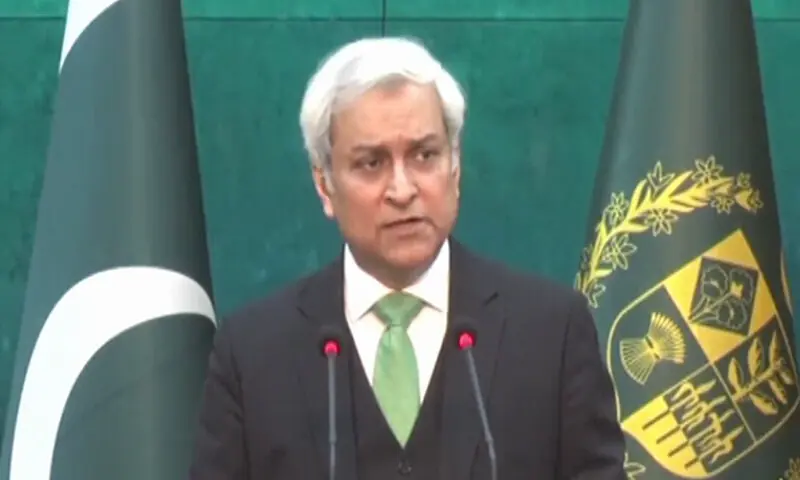
In a weekly press briefing, Foreign Office (FO) spokesperson Tahir Hussain Andrabi talked about the “abrupt variation” in the flow of the Chenab River, noting that it had been in the news in the past week.
Several media outlets reported this week that India had released water into the Chenab River.
“Pakistan views these variations with extreme concern and seriousness. They allude to unilateral release of water into the Chenab River by India, without any prior notification,” Andrabi said.
“Our Indus water commissioner has written a letter to his Indian counterpart seeking clarification on the matters in accordance with the procedures enshrined in the Indus Waters Treaty,” he said.
“Any manipulation of river flow by India, especially at a critical time of our agricultural cycle, directly threatens the life and livelihood as well as food and economic security of our citizens,” he said.
“We call upon India to respond to the queries raised by the Pakistani Indus water commissioner, refrain from any unilateral manipulation of river flow and fulfil its obligations in letter and spirit under the Indus Water Treaty provisions,” he said.
He further said that the Indus Waters Treaty was a “binding international agreement”, which had been “an instrument of peace and security and stability in the region”.
Under the 1960 Indus Waters Treaty, three rivers that flow westwards — Indus, Chenab and Jhelum — were awarded to Pakistan, with India getting three eastern-flowing rivers of the Indus Basin.
Andrabi said that violating the treaty threatened the “inviolability of international treaties and compliance with international law” and also posed a serious threat to “regional peace, principles of good neighbourliness, and norms governing interstate relations”.
“The international community must take notice of India’s continued disregard of a bilateral treaty, and counsel India to act responsibly and in accordance with international law and established norms as well as its own obligations,” Andrabi said.
“Pakistan remains committed to the peaceful resolution of disputes and issues with India but will not compromise on the existential water rights of the people of our country,” he said.
In April, India had held the Indus Waters Treaty in abeyance following the attack on tourists in occupied Kashmir’s Pahalgam that killed 26 — an incident New Delhi blamed on Islamabad without evidence. Pakistan termed any attempt to suspend its water share under the treaty an “act of war”, noting the treaty had no provision for unilateral suspension.
It later said it was considering court action, citing a violation of the 1969 Vienna Convention on the Law of Treaties.
In June, the Permanent Court of Arbitration (PCA) — an organisation that provides framework for international disputes — issued a Supplemental Award of Competence, stating that India cannot unilaterally hold the treaty in abeyance.
The supplemental award was issued in a 2023 case that Pakistan brought to the PCA over the design of Indian hydropower projects on rivers that were awarded to Pakistan under the treaty.
Removal of Indian woman’s hijab
During his press briefing, the FO spokesperson also talked about Bihar Chief Minister Nitish Kumar pulling down a female doctor’s hijab this week, a move which had invited criticism.
Noting the incident, Andrabi said that the incident was followed by the “public mocking” of a minister from Uttar Pradesh. A minister from Uttar Pradesh had defended Kumar, before backtracking.
“The forcible removal of the Muslim woman’s hijab by a senior political leader and subsequent public ridicule of this act are deeply disturbing and warrant strong condemnation,” he said.
“The action risks normalising the humiliation of Muslim women in India. The conduct also demonstrates public disrespect of India’s religious minorities, particularly its Muslim citizens,” he said.
“Such conduct reflects a broader and troubling pattern associated with Hindutva-inspired politics, namely the alarming rise of religious intolerance and Islamophobia,” he added.
“We urge all responsible stakeholders and the Indian government to recognise the seriousness of this incident and to reaffirm their commitment to the protection of minority rights, respect for religious freedom, and the preservation of human dignity,” he said.







 American Dollar Exchange Rate