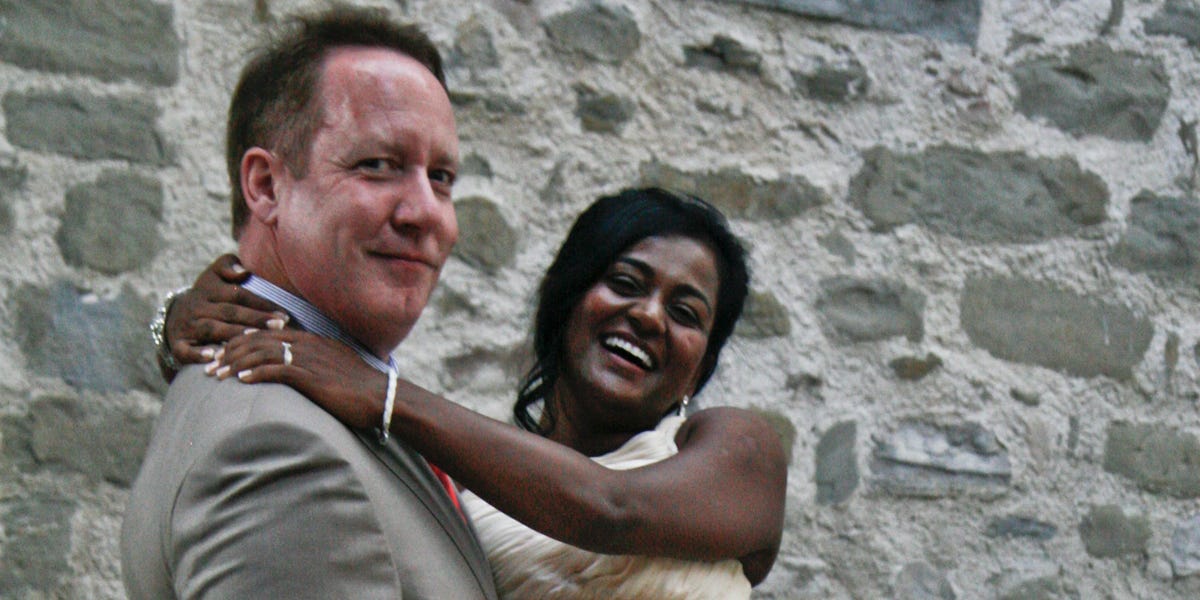
Courtesy of Indu Navar.
- Indu Navar has spent her career in tech, building and investing in organizations in Silicon Valley.
- She founded the Peter Cohen Foundation and EverythingALS after her husband died of ALS.
- Cohen had a long tech career, too. He built Amazon Mechanical Turk and AWS at Amazon.
This is an As-Told-To essay based on a conversation with Indu Navar, the CEO and Founder of EverythingALS. It has been edited for length and clarity.

Both my husband and I have been on the ground floor building technology that changed the world.
I have degrees in electrical engineering and computer science. I started my career at NASA and was on the founding team of what is today's WebMD. Then, I started another company that I ran for 14 years. After that, I was investing and advising. I've always been fascinated with big data and building analytics on top of it. My husband, Peter Cohen, worked at Amazon for about 18 years. He joined around 1996 or 1997 and built Amazon Mechanical Turk, a crowd-sourcing marketplace.
Life was really good. Here we are making change. He was still in his late forties, and then he started saying, "Hey, I think something is wrong with my ankle. It's not dorsal flexing."
We're like, "Oh, no big deal, it's just an ankle issue." No, it was a spine issue. Oh no, it was a brain issue. It took us two years to figure out that it was actually ALS, which is degenerative. The method of diagnosing ALS is called elimination, so you eliminate other diseases and problems. I think we spent over $100,000 just to diagnose it.
Every 90 minutes, somebody is getting diagnosed with ALS, and they're hearing the same diagnosis they heard 80 years ago. You have 2 to 5 years to live from your first symptom. That's what shocked me. It takes a long time to get diagnosed, and we diagnose late compared to other diseases, like cancer. A lot of people pass away without even being diagnosed.
Peter was diagnosed in 2018 and passed away in 2019. It shook us. It shook us in a way that, as entrepreneurs and as problem solvers, we ask how this is in such a dire state where we haven't done something about it in 80 years? This problem is very opaque until you've gone through it.
I started a nonprofit in his name called the Peter Cohen Foundation. My goal is to be able to say that he helped cure ALS with what he went through. We used to talk all the time about what we would do differently if we knew this problem existed before it happened to us.
Our goal with the Peter Cohen Foundation and EverythingALS is to bring technology innovations to ALS and other neurodegenerative diseases. We do everything from monitoring and assessing what is happening in clinical trials and using sensors to predict what will happen. The sensors measure patients' speech, breathing, walking, and fine motor skills.
Today, we don't actually have the tools to figure out if the drug you give a patient is really working because the way they evaluate your deterioration is by asking you, "On a scale of 1 to 4, how is your speech? How is your walking? How easy is it for you to cut your food?" For us, we're vegetarians. We don't cut our food, so how would we know how to answer that? It's called a patient-reported outcome, and a lot of the questioning has not evolved in years.
By using sensors, we don't have to wait for you to get to the point where you can't do things. We can actually predict where you're going to be in 3, 6, 9, or 12 months. We'll use them for early diagnosis. We've digitized a lot, and our algorithm is in clinical trials.
We call it citizen-driven research because we go directly to patients and do research with people who are being affected by the disease, so we can get thousands of people involved. We send the sensors to them, they wear them, and we monitor them remotely.
We have an EverythingALS app that lets patients talk to others who have ALS and have gone through this journey. They can also talk to our LLM-based generative AI tool, but it's not like talking to ChatGPT. Our AI is really walled off and trained only with the data we have and the 220 hours of experts who have spoken to us. It's a very trusted dataset.
Right now, we are moving to applying our process to our first other disease, which is Alzheimer's. Huntington's and Parkinson's will be in the near future as well. Our goal is to move the needle and fill the gap. We just felt like there was an unmet need in terms of how we care for people, and if you don't care for people, you'll never come up with a cure.


 American Dollar Exchange Rate