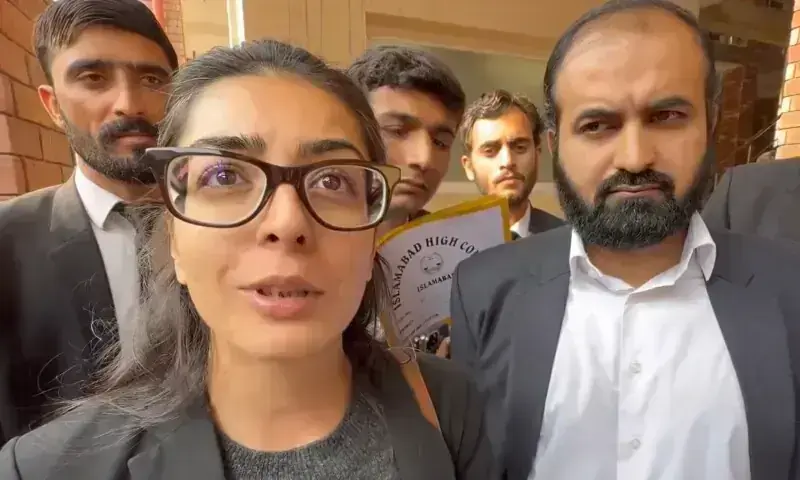

An Islamabad district and sessions court on Saturday completed the examination of prosecution witnesses in the controversial social media post case against lawyer and rights activist Imaan Zainab Mazari-Hazir and her husband, Advocate Hadi Ali Chattha.
The case against Imaan and Hadi was registered on the accusations of attempts to incite divisions on linguistic grounds through social media posts and of creating the impression that the armed forces were engaged in terrorism within the country.
During the previous hearing, Imaan and Chattha had objected after the apparent vanishing act of the court-appointed lawyer representing them in the case and the appointment of a new counsel.
Two days prior, the counsel appointed by the court had refused to cross-examine the prosecution’s witnesses, saying that he could not “ask questions dictated” to him.
The hearing today — held amid tense exchanges between police officials and lawyers — resumed with the state counsel continuing the witness examination process, where five witnesses appeared before the presiding judge, Additional District and Sessions Judge Afzal Majoka.
As the proceedings began, Advocate Chatha opened his counter-arguments by informing the court that he had forgotten his case file after learning that arguments were beginning without his presence. He said he had subsequently retrieved the file, adding that the prosecution had not addressed several points he had raised earlier.
He clarified that he never argued that the Pakistan Telecommunication Authority (PTA) was the “appropriate forum” in the matter. Instead, he said, his contention was that two official approvals were required before any inquiry could be initiated under the law.
Judge Majoka remarked that if there was ambiguity regarding the authority of the concerned officer, the 2025 amendment could be examined.
“What power was used while issuing the standard order?” the judge asked, observing that the standard order “is not in accordance with the 2018 rules”.
Advocate Mazari argued that similar cases had earlier been registered against journalists, after which directions were issued by the Islamabad High Court. Chattha further contended that the prosecution had failed to specify the timing of the alleged posts, adding that some screenshots were from 2021 while his current account was created in January 2025.
Showing his account to the judge, he maintained that “no tweet can be used against me” from a period before the creation of the account.
He added that all four charges framed against him and Imaan referenced 2021, even though his current account did not exist at that time. Citing various court judgments, he requested his acquittal. After hearing his arguments, Judge Majoka reserved the decision and later announced that the acquittal application stood rejected.
Following the rejection, the court moved to the evidence stage and summoned prosecution witnesses for cross-examination. At this point, Advocate Mazari informed the court that her counsel was not present. When the judge directed her to call her counsel, Mazari responded that the lawyer in question was not representing her.
This sparked a bitter exchange between Mazari, Advocate Chatha and the state counsel.
The state counsel complained that he was being subjected to verbal hostility.
Judge Majoka warned the accused not to disrupt proceedings, telling them he would remove them from the courtroom if necessary. He summoned the ladies’ police and moved the state counsel to the rostrum to proceed with the cross-examination.
However, tensions escalated further when Mazari told the judge: “This is a military court,” and subsequently accused the state counsel of being a “tout”.
The judge ordered both accused to be removed from the courtroom, and police officers escorted them out. Lawyers and police personnel exchanged harsh words in the courtroom afterwards, and the atmosphere remained volatile.
Proceedings resumed after a brief break. Advocate Mazari filed an acquittal application and sought its immediate hearing, but the judge rejected the request and issued notices instead.
Chattha told the court he had repeatedly attempted to contact their counsel, but he could not reach the court. The judge directed the state counsel to proceed with cross-examination in the absence of the defence counsel.
The state counsel then examined witnesses Aneesur Rehman, Shahroz, Waseem, and Imran Haider. The fifth and final witness, Afzal, arrived late, prompting the judge to warn that he would close the evidence stage if the witness did not appear.
The prosecution assured the court that the witness was on his way, and once Afzal arrived, his testimony was recorded, completing the prosecution’s evidence.
At the conclusion of the examination process, the judge directed the prosecution to prepare and submit the questionnaire under Section 342 of the Code of Criminal Procedure to the accused.
“You are being given the questionnaire; you must submit your answer,” the judge said, adding that if the accused failed to submit their responses, the state counsel would be responsible for doing so.
The court directed the prosecution to submit the completed questionnaire by December 4 and adjourned the hearing until the same date.





 American Dollar Exchange Rate