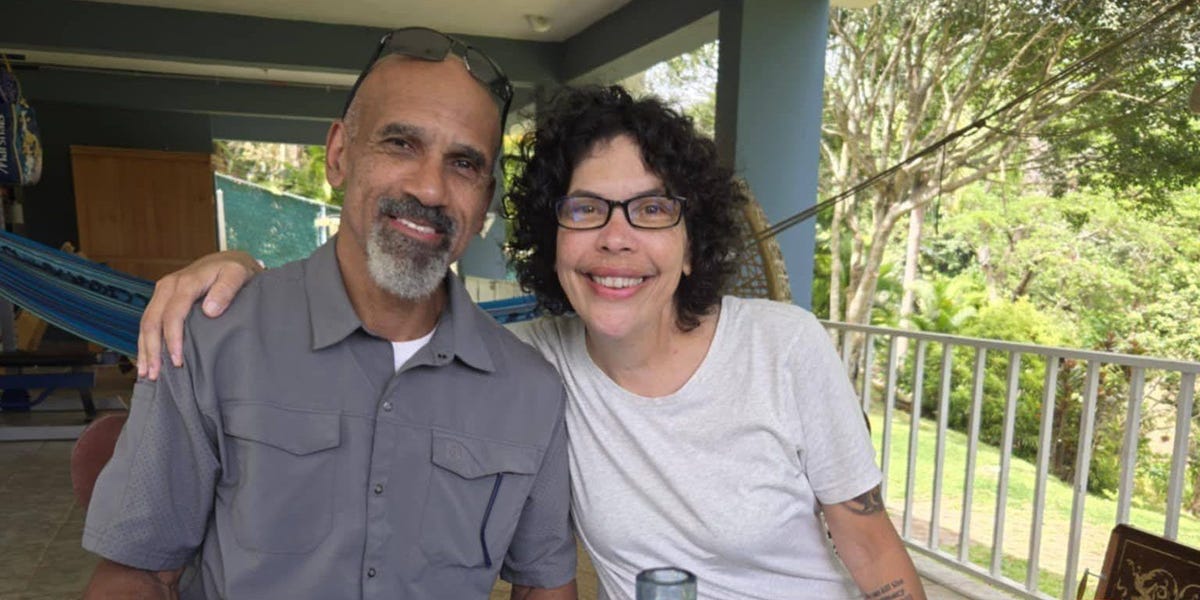
Courtesy of Sarah Ratliff
- My husband and I didn't boast about our relationship when we worked together in the corporate world.
- Now we own a business. Clients know we're married, but we keep work and personal lives separate.
- We've learned how to maintain a strong connection despite always being around each other.
My husband and I have worked together for the last 15 years. People ask us how we keep our marriage healthy despite being together 24/7. For us, it's easy, but like marriage itself, it does take work.

This is the second time in our 25-year marriage that Paul and I have worked together. The first time, we were both employed by the same large biotech company in Southern California, although in very different roles. Today, we run a small consulting business.
Indeed, those two scenarios are night and day different; however, both raise similar issues about respecting boundaries and checking our egos.
The first time we worked together, we kept our marriage out of it
Paul was initially hired by the Information Technology (IT) division to manage the company's email and storage. IT is one of those functions that operates primarily in the shadows. Their job is simple: keep the lights on, so to speak. IT professionals often work behind the scenes but are crucial to everyday operations. People don't think much about IT until something breaks or someone breaches the firewall.
My job was a little more visible. I was hired at the same company two years later as an executive assistant supporting a newly recruited department head for a brand new team focusing on health economics.
The department examined patient health outcomes and was an experiment. Frankly, very few at the executive level believed we'd achieve much, but we far exceeded expectations. I went from supporting my boss alone to managing five of his direct reports and overseeing two long-term projects with numerous deliverables that spanned multiple departments.
If someone made the connection between Paul and me — usually by noticing our shared (and unusual) last name in the company directory — we didn't deny it, but there were no neon signs giving us away either.
Apart from not wanting to be the couple that argues one minute and then shows PDA the next, we also wanted to avoid colleagues using our relationship to their advantage. He didn't want people using me to get tickets assigned to his team prioritized over others. I didn't want people bothering him to get on my boss's calendar or influence processes.
When people found out, oftentimes they were surprised — and that was fine. We're very different and maybe even a little mismatched. My position brought high visibility. I knew most everyone on campus, even if only by name. By contrast, Paul is quiet, analytical, and deliberate. He keeps to himself. That contrast actually helped us. We weren't seen as interchangeable.
Looking back, we didn't really have a conversation about how we'd handle working for the same company. There was nothing to prove to anyone or even to each other. We just wanted to do our jobs without complicating things or bringing unwanted attention to ourselves.
Mission accomplished. When we left the corporate grind to live on a farm in Puerto Rico in 2008, there were no joint parties. We arrived as individuals with the same last name, and we left the same way.
We still try to keep our business and personal lives separate
I often use the phrase "hakuna matata" from "The Lion King" to describe how we approach marriage and working together these days. We let most everything roll off us, even stress.
We run Mayani Farms, an eco-organic farm, and we consult others on how to do the same. All of our clients know we're a husband-and-wife team. This works well because our skills and personalities complement each other. I manage the marketing, project management, and administrative functions. Paul has more experience as a farmer than I do. He is the consultant and designer who bridges clients' desires with what's possible for sustainable growth in the tropics.
Our current dynamic reflects what other couples experience when working together. We both loathe arguing. We can still count on one hand how many arguments we've had since we met 30 years ago. We like peace, and we strive for it daily. Sure, we both do things that might get on the other's nerves, but we have the experience to know that taking a walk can do wonders — especially when you're working on a beautiful island.
In our previous life, keeping the peace meant keeping our personal and professional lives separate. On the farm, it means respecting each other's job descriptions. Sometimes it can mean picking one's battles. Most things aren't argument-worthy because, we wonder, is it about being right or being heard? If it's the former, we can always come to an agreement. If it's the latter, it's time for a check-in with each other. Obviously, our marriage comes before everything, but sometimes protecting the relationship means being disciplined about how and where work shows up or how to address a personal issue.
Supporting a marriage and supporting a business are very similar
We've also found that there's a broader truth that applies whether people are building a company, a life together, or both: marriages and businesses can falter for some of the same reasons. People repeat patterns that have proven themselves to be ineffective. And many fail to see beyond the car in front of them. Paul and I both believe that long-term success in either arena depends on a willingness to adapt, to grow, and to make intentional choices before small cracks turn into structural problems.








 American Dollar Exchange Rate