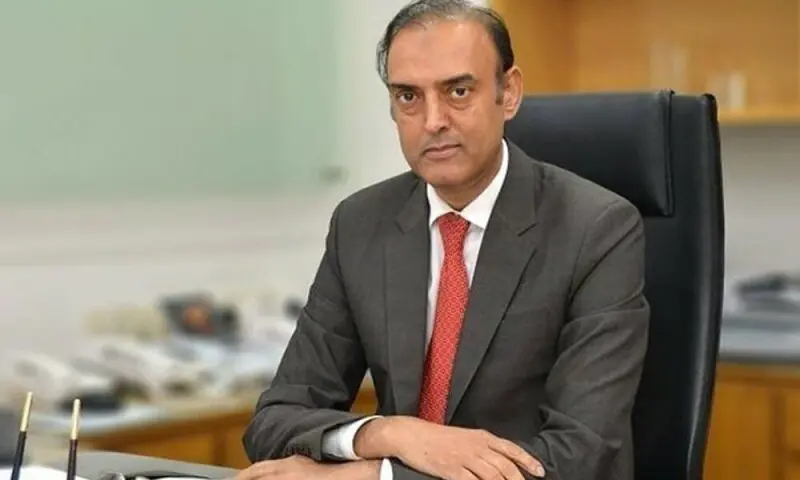

KARACHI: State Bank of Pakistan (SBP) Governor Jameel Ahmad on Tuesday called for integration of regional capital markets to mobilise financing for critical projects, including related to climate change and infrastructure.
He noted that the banking sector alone could not meet the country’s long-term investment needs, saying the domestic economy moved toward a higher growth trajectory.
“With the [Pakistan’s] economy having stabilised and now on course for higher growth, we are in a stronger position to undertake a series of structural reforms, including deepening of our financial markets,” Governor Ahmad said speaking at the international capital market conference and exhibition 2025 titled ‘Regional Integration and innovation in Capital Markets: A New Era of Cooperation’, organiaed by the Securities and Exchange Commission of Pakistan (SECP) on Tuesday.
“In economies with low saving rates where bank financing alone cannot meet long-term investment needs particularly for climate and infrastructure projects, regional capital markets can play a pivotal role.”
Aurangzeb: SBP chief to push banks for enhanced private sector financing
He maintained that the potential integration of capital markets in Asian region represented a “historic opportunity”.
“It would be a pathway to harness the region’s savings for its own development. It will strengthen financial stability and it will amplify our collective voice in the global financial system. We must act with vision and enhanced coordination.”
Ahmad said economies had faced a series of global and domestic shocks since the onset of the pandemic Covid-19.
Responding effectively to these challenges has been beyond the scope of any single country to manage in isolation. Yet many economies were unable to draw upon support from international capital markets, with rising benchmark yields and a marked increase in risk premiums demanded by foreign investors, according to the central bank chief.
Domestically too, the financial markets of many economies were dominated by commercial banks that possess limited capacity to provide financing at a scale required by governments, without constraining credit flow to the private sector, he added.
“Although the global capital markets dynamics have become somewhat favorable over the past year, they continue to remain highly susceptible to prevailing global trade uncertainty, the reorientation of supply chains, and persistent political frictions to name a few.
“In this context the role of regional market integration has assumed considerable significance,” he underlined.
Asia, according to SBP governor, provides a unique opportunity due to its inherent heterogeneity both in funding gaps and investment returns.
“Some countries have deposit base exceeding 130% of GDP [gross domestic product] but lack sufficient domestic investment avenues to generate competitive returns. Others with deposit bases below 30% of GDP face substantial financing needs and offer promising returns to investors. Greater regional integration can bridge this gap and unlock mutual benefits for all stakeholders.
“While the integration holds great promise, it does not come without risk. Greater interconnection can amplify contingency in times of financial stress. Divergent policy priorities or uneven market development may also create imbalances,” he said.
“To mitigate these risks, we must take essential precautionary measures. They include a well-designed and functioning regional services framework involving coordination among central banks, securities regulators and finance ministries. Also, developing local currency debt markets can help reduce participants’ exchange rate risk.”
On Monday, Jameel Ahmad stated that there existed gaps in the credit and investment requirement of the private sector in the country, as he urged capital markets to increase the level of transparency in their operations to strengthen public trust and attract investments.
Ahmad maintained that Pakistan had achieved significant macroeconomic stability by pursuing coordinated and prudent monetary and fiscal policies, leading to a sharp reduction in inflation, and a rebuilding of external and fiscal buffers.






 American Dollar Exchange Rate