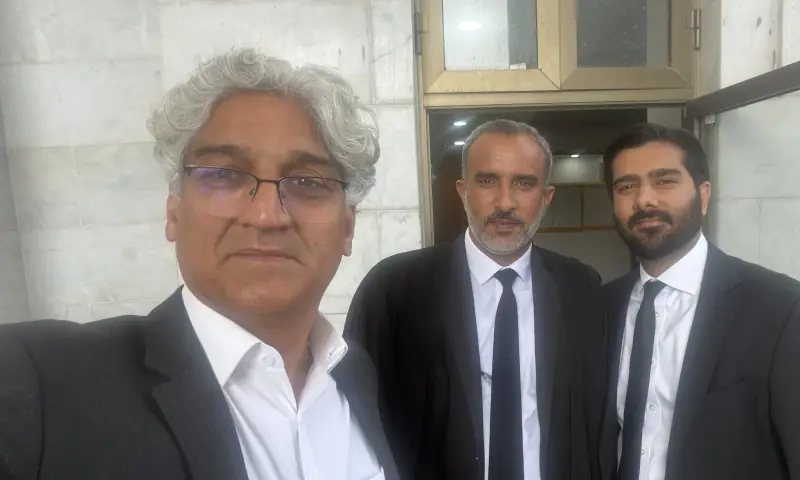

ISLAMABAD: In a dramatic development in the narcotics and terrorism case against senior journalist Matiullah Jan, a forensic report submitted to the Islamabad High Court (IHC) on Thursday revealed that the substance allegedly recovered from him was not a prohibited drug.
The case — registered at Margalla Police Station on Nov 28, 2024 — had accused the journalist of snatching a government-issued rifle, hitting a vehicle at a police barrier and possessing narcotics.
Initiation of legal proceedings against Jan drew strong criticism from journalist bodies and rights groups, who maintained that he was being targeted for investigating reports of alleged deaths during law enforcement action against PTI protesters in November 2024.
On Thursday, a division bench comprising Justice Arbab Muhammad Tahir and Justice Raja Inaam Ameen Minhas heard the matter in a packed IHC courtroom. During the hearing, the Islamabad police placed on record a laboratory report prepared by the Punjab Forensic Science Agency.
According to the forensic analysis, the material allegedly recovered from the journalist did not contain methamphetamine — commonly known as “ice”.
The courtroom was filled with members of the legal fraternity, political workers and journalists expressing solidarity with Jan.
When former senator Farhatullah Babar was spotted in the courtroom, Justice Tahir inquired about his presence. Babar responded that he had come to show support for the senior journalist.
Advocate Rai Hanif Rahi informed the bench that lawyers had appeared in solidarity, while journalist Saqib Bashir submitted that the case had been pursued “as if Matiullah Jan were a drug dealer”.
The advocate further apprised the court that the matter had been fixed before the trial court for framing of charges.
Observing that the forensic findings carried significant legal implications, the bench questioned whether narcotics-related charges could be sustained in the absence of a prohibited substance.
The judges remarked that an appropriate order would be passed and subsequently referred the matter back to the trial court for further proceedings.
A day ago, an Islamabad ATC had rejected Jan’s application challenging the jurisdiction of the court and fixed February 19 (today) as the date for framing of charges.
The case
On Nov 28, 2024, Jan’s son had posted on X about his father being “abducted from the parking” of the Pakistan Institute of Medical Sciences (Pims) in Islamabad by “unmarked abductors in an unmarked vehicle”.
Authorities later the same day confirmed he had been booked in a first information report (FIR), which claimed that Jan was found possessing 246 grams of narcotic methamphetamine (crystal meth) when his vehicle was stopped at E-9 in the federal capital. The case was registered at 3:20am, nearly an hour after the alleged incident took place.
Jan was initially sent on a two-day physical remand in police custody by an Islamabad Anti-Terrorism Court (ATC). However, the next day, the Islamabad High Court (IHC) overturned that decision and sent him to judicial custody.
On Nov 30, 2024, the journalist was granted bail by the ATC and subsequently released from the Adiala jail.
On Oct 31, 2025 — the day Jan was set to be indicted — an ATC issued a notice to police on the journalist’s application for the provision of case documents.
The FIR invoked Control of Narcotic Substances Act (CNSA) 1997’s Section 9(2)4, which specifies the punishment for possessing or trafficking “more than 100g and up to 500g” of psychotropic substance.
The FIR also invoked Sections 7 of the Anti-Terrorism Act (ATA) 1997 as well as Sections 186 (obstructing public servant), 279 (Rash driving or riding on a public way), 353 (assault or criminal force to deter public servant from discharge of his duty), 382 (theft after preparation made for causing death, hurt or restraint), 411 (dishonestly receiving stolen property), 427 (mischief causing damage to the amount of Rs50) and 506ii (threat to cause death or grievous hurt) of the Pakistan Penal Code.





 American Dollar Exchange Rate