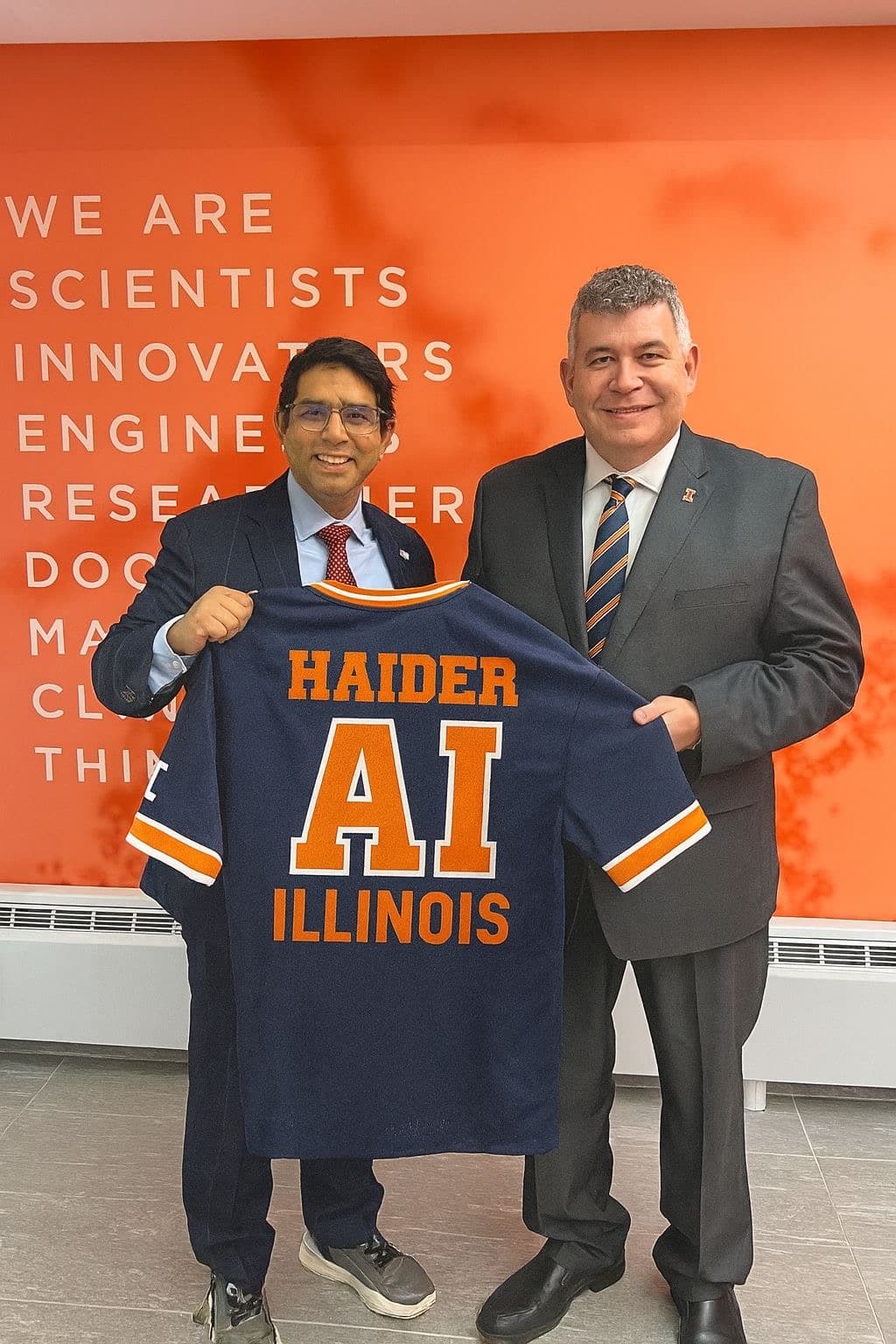
Dr. Adil Haider, a globally recognized surgeon-scientist and founder Boston Health AI, has been appointed as the Inaugural Chief Artificial Intelligence Officer (CAIO) at the Carle Illinois College of Medicine (CI MED), the world’s first engineering-based medical school.

The appointment marks a major global milestone for Dr. Haider, whose career spans clinical excellence, academic leadership, and health-technology innovation across the United States, United Arab Emirates and Pakistan. In this newly created role, he will lead the strategic vision and responsible deployment of artificial intelligence across CI MED, advancing AI-enabled medical education, translational research, and clinical innovation.
Dr. Haider joins Carle Illinois following a transformative 6.5-year tenure as Dean of the Aga Khan University Medical College in Pakistan, where he led one of the most ambitious growth periods in the institution’s history. Under his leadership, the medical college quadrupled its research funding, achieved top-100 global ranking status, and earned multiple international accreditations, including ACGME-International and AACME. Widely admired for his accessibility and mentorship, Dr. Haider was a student favorite and became well known on campus for his signature sneakers and deep engagement with learners.
“Working across healthcare systems around the world has taught me that technology alone does not transform care – context, trust, and clinical reality do,” said Dr. Haider. “Artificial intelligence gives us a powerful opportunity to strengthen systems of care at scale, but only if it is built responsibly, governed thoughtfully, and grounded in real clinical needs.”
At CI MED, Dr. Haider will guide how AI is governed, evaluated, and integrated across medicine, engineering, and data science, ensuring that innovation remains clinically relevant and patient-centred. His appointment reinforces CI MED’s position at the forefront of medical education and innovation – where engineering rigor, clinical excellence, and artificial intelligence converge to define the future of healthcare.
“By establishing the role of chief AI officer, Carle Illinois is signaling that artificial intelligence is not peripheral, but foundational to the future of medicine,” said CI MED Dean Mark Cohen. “Dr. Haider brings a unique combination of academic rigor, clinical expertise, and entrepreneurial experience. His leadership will help ensure that AI at Carle Illinois is innovative, ethical, and meaningfully improves health outcomes, transforming our clinical, research, innovation, and educational missions for the future.”
In addition to his role at CI MED, Dr. Haider will serve as Medical Director for Research Informatics at Carle Foundation Hospital, strengthening alignment between academic innovation and real-world clinical practice. He will also serve as a Visiting Professor in the Siebel School of Computing and Data Science within the Grainger College of Engineering, creating a rare bridge between medicine, engineering, and computing.
Prior to his deanship, Dr. Haider served as Kessler Director of the Center for Surgery and Public Health, a joint program of Brigham and Women’s Hospital and Harvard Medical School. Earlier in his career, he spent nearly a decade at Johns Hopkins School of Medicine, where he was a practicing trauma surgeon and founding Director of the Center for Surgical Trials and Outcomes Research.
An internationally recognised leader in outcomes research and health equity, Dr. Haider has authored over 450 peer-reviewed publications and secured more than USD 200 million in externally funded research. He has mentored over 150 trainees across multiple countries, many of whom now hold leadership roles in academia and healthcare systems globally.
In 2024, Dr. Haider founded Boston Health AI, a health-tech firm operating in the United States, the United Arab Emirates, and Pakistan. With Hami, the world’s first AI-clinical intelligence companion, Dr. Haider’s professional mission is ambitious: to help improve the care of one billion patients globally through ethical, scalable, and evidence-based applications of artificial intelligence in healthcare.
“The future of healthcare will be defined by how well we integrate technology without losing trust,” Dr. Haider added. “My focus remains on building solutions that are rigorous, ethical, and grounded in real clinical needs – whether in Pakistan, the US, or anywhere in the world.”
Indeed, Dr. Haider’s journey stands as a powerful example of how academic excellence and leadership can shape the future of medicine worldwide.
For more information, visit:
LinkedIn: www.linkedin.com/company/bostonhealth-ai
-ends-








 American Dollar Exchange Rate